
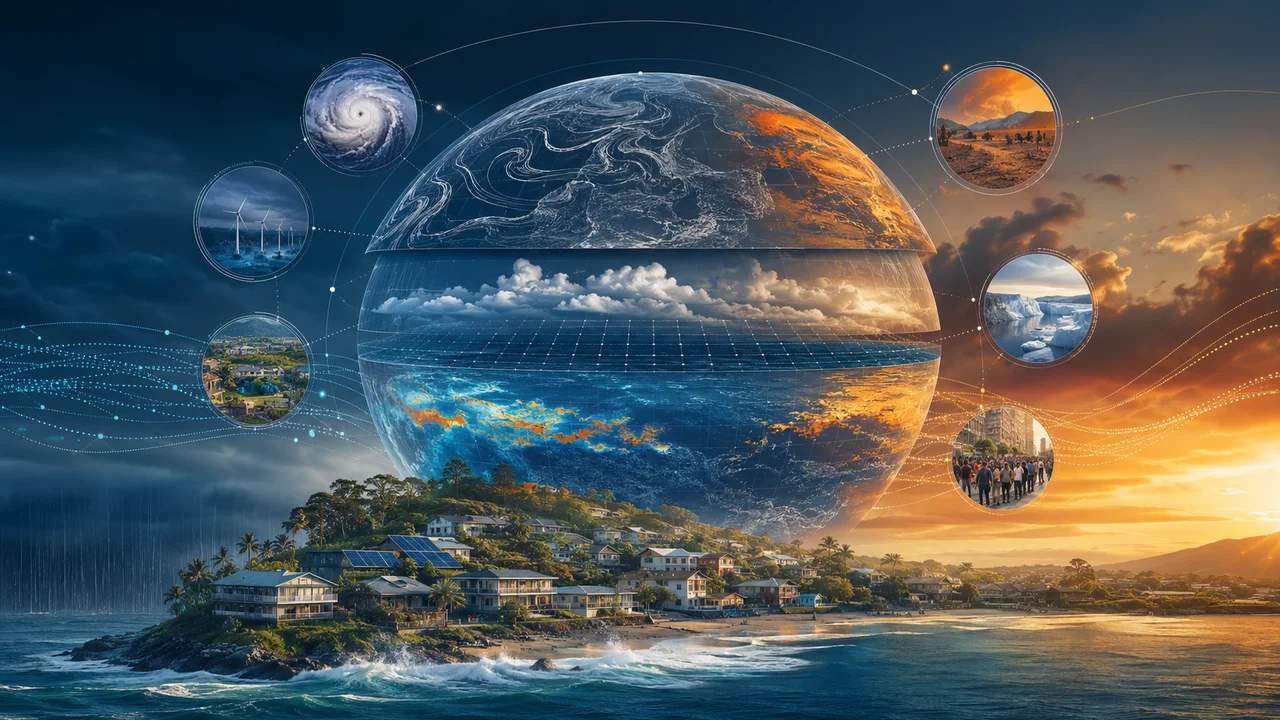
Climate models combine physics and observations to explore possible futures, supporting risk planning without predicting every local event exactly. Climate models are mathematical representations of the atmosphere, oceans, land, ice and their interactions, built from physical laws and observations. They simulate patterns and responses under different conditions rather than predicting the exact weather at one location on one future date. Their value lies in testing mechanisms, ranges and scenarios that inform risk decisions.
This guide develops climate models and risk through six specific lenses: physical foundations, observational data, model resolution, scenario pathways, uncertainty ranges, and decision use. The purpose is practical understanding. Readers should be able to recognise the mechanism, ask better questions of a provider or decision-maker and choose a proportionate next step without treating uncertainty as either proof of failure or permission for exaggerated claims.
The discussion considers the experience of researchers, engineers, policymakers and affected communities and keeps the analytical boundary wide enough to include the full system rather than the most favourable laboratory or project boundary. That matters because progress in climate models and risk should be visible through replicated measurement, comparison, uncertainty ranges and long-term observation, not inferred from attention, purchase or participation alone.
Physical foundations in the context of How Climate Models Help Us Understand Risk
Physical foundations include conservation of energy, mass and momentum, radiation and fluid motion. Because processes occur across scales, some features such as clouds or turbulence are represented through parameterisations. These approximations are tested and improved. A model is not a guess simply because it cannot calculate every molecule; all useful physical modelling involves appropriate scale.
The important shift is from recognising physical foundations as a desirable phrase to defining how it changes a real decision about climate models and risk. Researchers, engineers, policymakers and affected communities may see different consequences, so the decision record should state whose experience is being used and whose may still be missing. The boundary for analysis is the full system rather than the most favourable laboratory or project boundary. Keeping that boundary visible prevents an attractive improvement in one place from transferring cost, risk or effort somewhere less visible.
Implementation should remain proportionate to consequence. For a low-risk decision about physical foundations, a short trial and simple notes may be sufficient; a high-consequence part of climate models and risk may require specialist review, formal approval and longer monitoring. In either case, collect replicated measurement, comparison, uncertainty ranges and long-term observation. Make support and complaint routes clear before launch. People should not have to experience a serious failure before discovering who is responsible for correction.
Responsibility should continue after launch. Decisions about physical foundations in climate models and risk need an owner who can answer questions, maintain the approach and respond when conditions change. Name a backup and keep essential information where the relevant people can find it. When responsibility exists only during a project meeting, predictable problems become urgent surprises and the people affected are left to discover their own workaround.
Observational data in the context of How Climate Models Help Us Understand Risk
Observational data support initial conditions, evaluation and understanding of past climate. Weather stations, satellites, ocean instruments, ice cores and other records have different coverage and uncertainty. Models are compared with many patterns, not tuned to reproduce one global number. Disagreement between observation and simulation can reveal measurement issues, variability or a process needing improvement.
The practical significance of observational data lies in the choices it creates for researchers, engineers, policymakers and affected communities. Within climate models and risk, those choices affect mechanism, comparative benefit, uncertainty, scale and lifecycle impact. A narrow review may report the easiest benefit and miss the wider experience. Following the full system rather than the most favourable laboratory or project boundary gives reviewers a more honest view of who gains convenience, who assumes new responsibility and which failures require a human route rather than another instruction.
The first step is to turn observational data into a question that can be answered: what should become better, for whom and by when? Apply that question to climate models and risk, then gather replicated measurement, comparison, uncertainty ranges and long-term observation. Numbers show scale, while conversations and observation explain the mechanism behind the pattern. Compare the result with a credible alternative, including the option of improving the current process. A new approach should earn expansion through evidence rather than novelty.
A resilience check asks what happens when normal resources are unavailable. For observational data in climate models and risk, consider loss of connectivity, staff absence, budget pressure, increased demand or a participant needing a different route. The response does not have to replicate ideal service perfectly, but it should protect the most important outcome. Testing recovery often reveals priorities more clearly than describing normal operation.
For a useful comparison with climate models and risk, read How Renewable Energy Changes the Electricity Grid. Its subject is different, but it shows how neighbouring science choices can expose dependencies that a narrow review misses.
Model resolution in the context of How Climate Models Help Us Understand Risk
Model resolution describes the size of grid cells and time steps, not overall truth. Higher resolution can represent mountains, coastlines and storms more explicitly but requires greater computing and does not remove every uncertainty. Regional downscaling adds detail using physical or statistical methods. Detailed output should not be mistaken for equally precise knowledge at every location.
The value of model resolution becomes clearer when it is compared with a credible alternative. For climate models and risk, the comparison may be the current method, a simpler change or a different allocation of resources. Researchers, engineers, policymakers and affected communities should assess each option across the full system rather than the most favourable laboratory or project boundary. The preferred route should explain not only what it improves but also why its additional cost, complexity or constraint is justified.
After the first trial of model resolution, hold a short evidence review with researchers, engineers, policymakers and affected communities. Compare the expected mechanism with what actually happened and use replicated measurement, comparison, uncertainty ranges and long-term observation to identify the difference. Separate a flaw in the idea from a flaw in setup or communication. Agree on one adjustment only, then repeat the observation. Controlled iteration produces clearer learning than a large redesign in which every variable changes at once.
Cost should be understood broadly. The price of model resolution within climate models and risk may include time, training, coordination, infrastructure and the burden of handling exceptions. A choice that looks inexpensive to one team may move unpaid work to customers, families or another public service. Record those transfers explicitly and compare them with the benefit before describing the approach as efficient.
Scenario pathways in the context of How Climate Models Help Us Understand Risk
Scenario pathways describe possible future emissions, land use, technology or policy assumptions. They are conditional inputs, not forecasts of what society will choose. Comparing pathways shows how risk changes under different decisions. Near-term differences may be influenced by natural variability and existing emissions, while long-term outcomes can diverge substantially.
Questions about scenario pathways involve both design and behaviour. A technically capable approach to climate models and risk may still fail if expectations, incentives or everyday routines work against it. Researchers, engineers, policymakers and affected communities should examine the full system rather than the most favourable laboratory or project boundary and identify the moment when people are most likely to abandon, misunderstand or work around the intended process. That moment is often a better starting point than adding another feature.
Use a pre-mortem before changing scenario pathways. Imagine that the planned approach to climate models and risk has failed six months later and ask researchers, engineers, policymakers and affected communities to suggest plausible causes. Group those causes around mechanism, comparative benefit, uncertainty, scale and lifecycle impact, then select signals from replicated measurement, comparison, uncertainty ranges and long-term observation that could provide early warning. Assign a response to the most serious risks. This exercise is useful because people can discuss weakness without having to oppose the whole idea.
Review must include the option to stop. Investments of time, money or reputation can make teams defend scenario pathways after its value has weakened. For climate models and risk, decide beforehand which result would justify revision or withdrawal. Preserve lessons from an unsuccessful test and explain them without blame. This creates a culture in which evidence can change direction, making future pilots more honest and less likely to repeat hidden assumptions.
This aspect of climate models and risk also provides context for The Science Behind Everyday Food Preservation. Reading the two articles together helps distinguish a general decision principle from the specific evidence required by each topic.
Uncertainty ranges in the context of How Climate Models Help Us Understand Risk
Uncertainty ranges arise from future choices, natural variability and differences in model response. A range does not mean nothing is known. Decisions often concern the probability and consequence of heat, rainfall, sea-level or other changes. Ensembles show which findings are robust and where plans should remain flexible. Low-probability high-impact outcomes may still justify preparation.
For climate models and risk, uncertainty ranges should be evaluated as part of a connected system. It influences mechanism, comparative benefit, uncertainty, scale and lifecycle impact, and those effects may appear at different times. Researchers, engineers, policymakers and affected communities need a shared description of the current situation before choosing an intervention. That description should cover the full system rather than the most favourable laboratory or project boundary; otherwise a successful first example may be treated as proof even though ordinary cases, exceptions or long-term responsibilities were never tested.
To act on uncertainty ranges, choose one real setting connected with climate models and risk and document the baseline. Ask researchers, engineers, policymakers and affected communities where friction, exclusion or misunderstanding currently occurs. Then test one bounded change and examine replicated measurement, comparison, uncertainty ranges and long-term observation. Avoid changing several elements at once, because the team will not know which produced the result. Agree in advance on a stop condition as well as a success measure; stopping a weak idea is a valid use of a pilot.
Communication should distinguish established evidence, reasonable expectation and speculation. Claims about uncertainty ranges in climate models and risk become more trustworthy when readers can see the setting, timeframe and limitation behind them. Plain language does not require pretending the issue is simple. It requires defining specialised terms, explaining the consequence of uncertainty and showing which decision can responsibly be made with the information available now.
Decision use in the context of How Climate Models Help Us Understand Risk
Decision use begins with the question, timescale and tolerance for failure. Infrastructure, health and water planning may need stress tests across several plausible futures rather than one central estimate. Combine model information with local exposure and vulnerability. Update decisions as observations and models improve, while avoiding delay when current evidence already supports no-regret risk reduction.
The consequences of decision use may appear before, during and long after the main decision about climate models and risk. That timing matters to researchers, engineers, policymakers and affected communities, because an early convenience can be followed by maintenance, support or access problems. Review the full system rather than the most favourable laboratory or project boundary at each stage and identify who has authority to respond. A benefit that depends on unresolved work being absorbed elsewhere should not be described as a complete improvement.
Set a decision threshold for decision use before investing further in climate models and risk. The threshold might concern quality, access, cost, reliability or harm, depending on the subject. Use replicated measurement, comparison, uncertainty ranges and long-term observation and explain how long the observation must run. If the threshold is missed, decide whether the cause can reasonably be corrected. This protects the review from being rewritten after results appear simply to defend the preferred option.
One common mistake is to optimise the visible part of decision use while ignoring maintenance and recovery. In climate models and risk, the long-term result depends on what happens after the first decision, when attention moves elsewhere and unusual cases appear. Document the smallest routine that keeps the improvement working. If that routine requires unavailable time, authority or skill, the design should be simplified before expansion rather than relying on permanent exceptional effort.
For a useful comparison with climate models and risk, read Can Low-Cost Sensors Improve Air Quality?. Its subject is different, but it shows how neighbouring science choices can expose dependencies that a narrow review misses.
Six questions to ask about climate models and risk
The following questions turn the six parts of climate models and risk into a focused review. They can be used by readers, teams or community groups without assuming that every setting needs the same answer.
- What does physical foundations mean in this setting, and who experiences its effects first?
- Which current problem involving observational data is the article trying to solve?
- What evidence would show that model resolution improved rather than merely changed?
- Who owns the long-term work associated with scenario pathways, including exceptions?
- Which group could be poorly served by the preferred approach to uncertainty ranges?
- What result would justify revising or stopping work on decision use?
Conclusion: a balanced view of How Climate Models Help Us Understand Risk
How Climate Models Help Us Understand Risk becomes useful when its six dimensions—physical foundations, observational data, model resolution, scenario pathways, uncertainty ranges, decision use—are understood together. The central promise is climate models combine physics and observations to explore possible futures, supporting risk planning without predicting every local event exactly. That promise should remain connected to evidence, affected people and the resources required after the initial decision.
The next step is not automatic adoption or rejection. Choose one situation involving climate models and risk, document the current outcome and test a proportionate improvement. Review the result honestly, preserve what helped and change or stop what did not. That creates a stronger basis for mechanism, comparative benefit, uncertainty, scale and lifecycle impact than confidence, novelty or fear alone.
Comments 0