
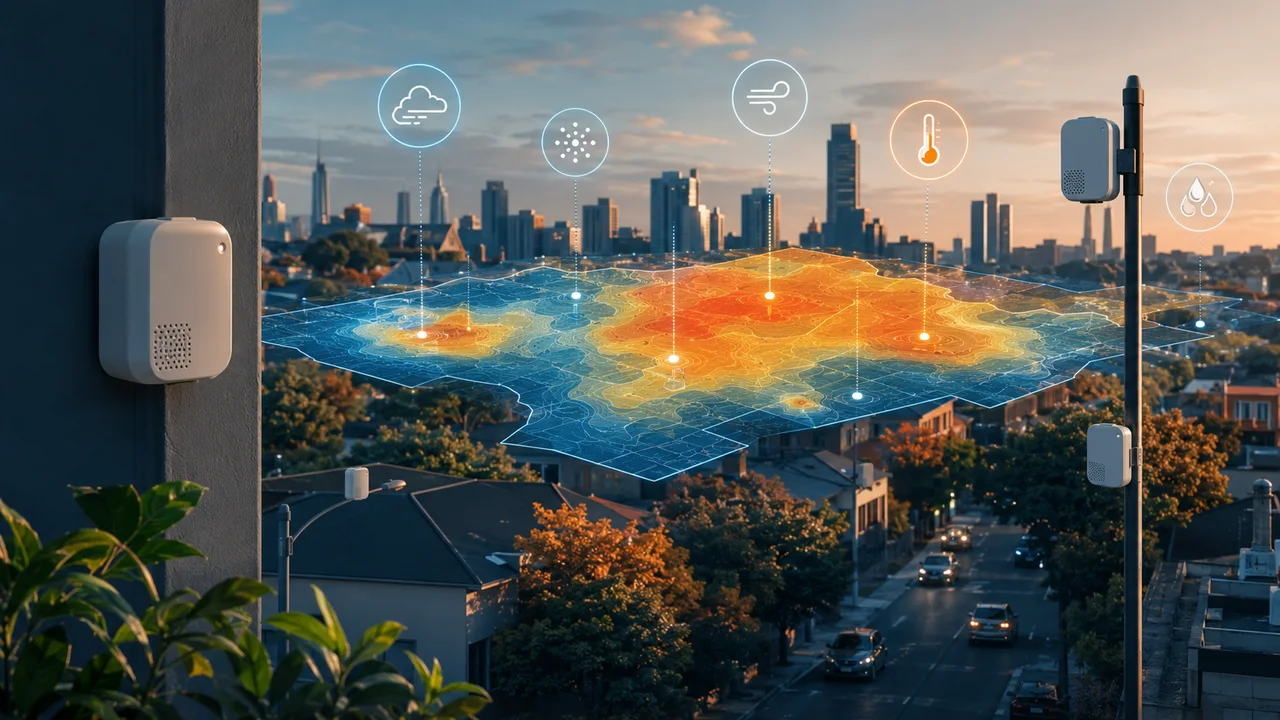
Low-cost air sensors can expand awareness and coverage when calibration, placement and careful interpretation prevent misleading conclusions. Low-cost air sensors can provide more locations and real-time awareness than reference monitoring alone, but their readings require interpretation. Many devices estimate particles or gases indirectly and respond to humidity, temperature or interfering pollutants. They are valuable for patterns, engagement and selected applications when calibration, placement, maintenance and communication match the intended decision.
Can Low-Cost Sensors Improve Air Quality? is best understood by separating its main components and then reconnecting them. The sections below examine pollutant types, sensor limitations, calibration, placement choices, community monitoring, and public communication. These are not interchangeable labels: each describes a distinct decision, dependency or source of evidence. Together they show why the subject cannot be judged from one headline benefit or one alarming example.
The discussion considers the experience of researchers, engineers, policymakers and affected communities and keeps the analytical boundary wide enough to include the full system rather than the most favourable laboratory or project boundary. That matters because progress in low-cost air-quality monitoring should be visible through replicated measurement, comparison, uncertainty ranges and long-term observation, not inferred from attention, purchase or participation alone.
Pollutant types in the context of Can Low-Cost Sensors Improve Air Quality?
Pollutant types require different sensing methods. Particulate matter, carbon monoxide, nitrogen dioxide, ozone and volatile compounds are not interchangeable. A device labelled ‘air quality’ may measure only one proxy. Choose the sensor after defining the health or environmental question and compare its range and detection limit with expected concentrations.
The consequences of pollutant types may appear before, during and long after the main decision about low-cost air-quality monitoring. That timing matters to researchers, engineers, policymakers and affected communities, because an early convenience can be followed by maintenance, support or access problems. Review the full system rather than the most favourable laboratory or project boundary at each stage and identify who has authority to respond. A benefit that depends on unresolved work being absorbed elsewhere should not be described as a complete improvement.
A practical review can begin with three columns: the current position on pollutant types, the change being considered and the evidence that would justify keeping it. For low-cost air-quality monitoring, suitable evidence includes replicated measurement, comparison, uncertainty ranges and long-term observation. Select a small number of measures before the result is known, add direct observations and record exceptions. Set a review date and name the person able to correct the design. If the evidence is mixed, retain the useful element while narrowing or revising the weak one.
Privacy, dignity and autonomy may be affected even when they are not the primary purpose of pollutant types. In low-cost air-quality monitoring, ask what information is collected, which choices remain available and whether refusing the preferred route creates a penalty. Proportionate safeguards should match the consequence. People need enough explanation to participate knowingly and a realistic way to correct a mistake or challenge an important outcome.
Sensor limitations in the context of Can Low-Cost Sensors Improve Air Quality?
Sensor limitations include drift, cross-sensitivity, environmental response, ageing and variation between identical units. Consumer displays may convert readings into an index without explaining the calculation. Review independent evaluations where available. A low price can support dense networks, but hundreds of uncertain values do not automatically equal one accurate measurement.
The practical significance of sensor limitations lies in the choices it creates for researchers, engineers, policymakers and affected communities. Within low-cost air-quality monitoring, those choices affect mechanism, comparative benefit, uncertainty, scale and lifecycle impact. A narrow review may report the easiest benefit and miss the wider experience. Following the full system rather than the most favourable laboratory or project boundary gives reviewers a more honest view of who gains convenience, who assumes new responsibility and which failures require a human route rather than another instruction.
Begin with a walkthrough focused only on sensor limitations. In relation to low-cost air-quality monitoring, ask one participant to describe the intended route and another to describe what happens when information, time or access is missing. Record replicated measurement, comparison, uncertainty ranges and long-term observation before proposing a fix. The contrast usually reveals assumptions hidden in the official process. Select the correction with the greatest expected benefit that can still be reversed if the result disappoints.
Learning should be preserved after the immediate decision. Keep a concise record of how sensor limitations was handled within low-cost air-quality monitoring, the evidence considered and the reason for the choice. Include dissenting observations that may become important later. When staff, technology or circumstances change, this record prevents an old decision from continuing only because its original assumptions have been forgotten.
This aspect of low-cost air-quality monitoring also provides context for How Renewable Energy Changes the Electricity Grid. Reading the two articles together helps distinguish a general decision principle from the specific evidence required by each topic.
Calibration in the context of Can Low-Cost Sensors Improve Air Quality?
Calibration compares sensor output with a suitable reference under conditions similar to use and develops a correction where justified. Co-location should cover relevant concentration and weather ranges. A correction from one city or season may not transfer. Continued checks are needed because performance can change. Calibration cannot rescue a sensor that lacks sensitivity for the question.
Questions about calibration involve both design and behaviour. A technically capable approach to low-cost air-quality monitoring may still fail if expectations, incentives or everyday routines work against it. Researchers, engineers, policymakers and affected communities should examine the full system rather than the most favourable laboratory or project boundary and identify the moment when people are most likely to abandon, misunderstand or work around the intended process. That moment is often a better starting point than adding another feature.
Implementation should remain proportionate to consequence. For a low-risk decision about calibration, a short trial and simple notes may be sufficient; a high-consequence part of low-cost air-quality monitoring may require specialist review, formal approval and longer monitoring. In either case, collect replicated measurement, comparison, uncertainty ranges and long-term observation. Make support and complaint routes clear before launch. People should not have to experience a serious failure before discovering who is responsible for correction.
Communication should distinguish established evidence, reasonable expectation and speculation. Claims about calibration in low-cost air-quality monitoring become more trustworthy when readers can see the setting, timeframe and limitation behind them. Plain language does not require pretending the issue is simple. It requires defining specialised terms, explaining the consequence of uncertainty and showing which decision can responsibly be made with the information available now.
Placement choices in the context of Can Low-Cost Sensors Improve Air Quality?
Placement choices affect what the device measures. Distance from roads, cooking, vents, walls, height and airflow can create very local readings. Indoor sensors should be placed away from direct emissions unless the purpose is to study them. Document location and changes. Power, connectivity and physical security also influence whether a network produces continuous usable data.
Different participants may use the phrase placement choices while referring to different problems. In a discussion of low-cost air-quality monitoring, researchers, engineers, policymakers and affected communities should define the term with a concrete example and relate it to mechanism, comparative benefit, uncertainty, scale and lifecycle impact. This avoids false agreement. It also makes it possible to inspect the full system rather than the most favourable laboratory or project boundary and decide whether the proposed action addresses the original need or merely changes the most visible symptom.
A useful workshop on placement choices would bring together researchers, engineers, policymakers and affected communities and map the experience from first contact through normal use, exception and recovery. Link each stage to low-cost air-quality monitoring and identify what information, skill or resource is required. Choose evidence from replicated measurement, comparison, uncertainty ranges and long-term observation, but do not let measurement displace the outcome. A metric is worth keeping only when a change in it would lead to a specific decision.
The language used to describe placement choices influences expectations. Marketing, policy or personal advice about low-cost air-quality monitoring should not turn a conditional benefit into a guaranteed outcome. State who the approach is intended for, what effort it requires and which limitations remain. Precise language helps suitable users make an informed choice and reduces disappointment that might otherwise be blamed on the people least able to influence the design.
For a useful comparison with low-cost air-quality monitoring, read The Science Behind Everyday Food Preservation. Its subject is different, but it shows how neighbouring science choices can expose dependencies that a narrow review misses.
Community monitoring in the context of Can Low-Cost Sensors Improve Air Quality?
Community monitoring can identify patterns, support questions and involve residents in research. Participants need training, clear ownership of data and protection from location or household information being exposed. Expectations should be honest: a project may reveal where further investigation is needed without providing regulatory evidence or an individual medical diagnosis.
In this context, community monitoring is not an isolated feature. It shapes decisions about mechanism, comparative benefit, uncertainty, scale and lifecycle impact and influences the experience of researchers, engineers, policymakers and affected communities. A responsible assessment follows the full system rather than the most favourable laboratory or project boundary, including cases that do not use the preferred route. Those edge cases are useful design evidence. They reveal whether low-cost air-quality monitoring works because the system is dependable or only because the first participants had unusual resources and support.
The first step is to turn community monitoring into a question that can be answered: what should become better, for whom and by when? Apply that question to low-cost air-quality monitoring, then gather replicated measurement, comparison, uncertainty ranges and long-term observation. Numbers show scale, while conversations and observation explain the mechanism behind the pattern. Compare the result with a credible alternative, including the option of improving the current process. A new approach should earn expansion through evidence rather than novelty.
Timing can change the conclusion. A short observation of community monitoring may capture novelty or setup problems rather than the durable effect on low-cost air-quality monitoring. Choose a review period that reflects how the outcome develops and note seasonal or one-off influences. At the same time, define early warning signals that justify immediate action; waiting for a scheduled review is not responsible when evidence suggests preventable harm.
Public communication in the context of Can Low-Cost Sensors Improve Air Quality?
Public communication should report pollutant, units, timeframe, data quality and uncertainty. Maps can imply precision beyond the network, while colour scales may alarm or reassure without context. Explain which actions are reasonable and which authority handles serious concerns. Do not compare uncorrected readings from different sensor models as if they were equivalent.
The value of public communication becomes clearer when it is compared with a credible alternative. For low-cost air-quality monitoring, the comparison may be the current method, a simpler change or a different allocation of resources. Researchers, engineers, policymakers and affected communities should assess each option across the full system rather than the most favourable laboratory or project boundary. The preferred route should explain not only what it improves but also why its additional cost, complexity or constraint is justified.
After the first trial of public communication, hold a short evidence review with researchers, engineers, policymakers and affected communities. Compare the expected mechanism with what actually happened and use replicated measurement, comparison, uncertainty ranges and long-term observation to identify the difference. Separate a flaw in the idea from a flaw in setup or communication. Agree on one adjustment only, then repeat the observation. Controlled iteration produces clearer learning than a large redesign in which every variable changes at once.
Interdependence deserves attention. Changes to public communication may rely on another team, public service, supplier or household behaviour outside the formal scope of low-cost air-quality monitoring. List those dependencies and confirm which are merely assumed. A plan is fragile when every element must perform perfectly. Build a fallback for the dependency most likely to fail and practise the handover before pressure makes improvisation necessary.
This aspect of low-cost air-quality monitoring also provides context for How Climate Models Help Us Understand Risk. Reading the two articles together helps distinguish a general decision principle from the specific evidence required by each topic.
Six questions to ask about low-cost air-quality monitoring
The following questions turn the six parts of low-cost air-quality monitoring into a focused review. They can be used by readers, teams or community groups without assuming that every setting needs the same answer.
- What does pollutant types mean in this setting, and who experiences its effects first?
- Which current problem involving sensor limitations is the article trying to solve?
- What evidence would show that calibration improved rather than merely changed?
- Who owns the long-term work associated with placement choices, including exceptions?
- Which group could be poorly served by the preferred approach to community monitoring?
- What result would justify revising or stopping work on public communication?
Conclusion: a balanced view of Can Low-Cost Sensors Improve Air Quality?
Can Low-Cost Sensors Improve Air Quality? becomes useful when its six dimensions—pollutant types, sensor limitations, calibration, placement choices, community monitoring, public communication—are understood together. The central promise is low-cost air sensors can expand awareness and coverage when calibration, placement and careful interpretation prevent misleading conclusions. That promise should remain connected to evidence, affected people and the resources required after the initial decision.
The next step is not automatic adoption or rejection. Choose one situation involving low-cost air-quality monitoring, document the current outcome and test a proportionate improvement. Review the result honestly, preserve what helped and change or stop what did not. That creates a stronger basis for mechanism, comparative benefit, uncertainty, scale and lifecycle impact than confidence, novelty or fear alone.
Comments 0