
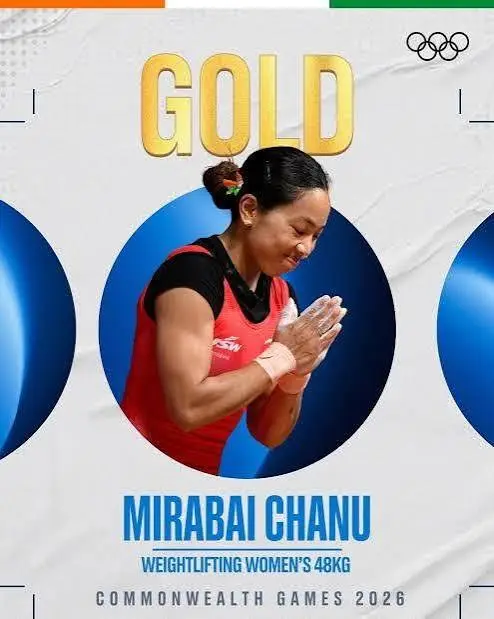
When Mirabai Chanu walked towards the weightlifting platform at the 2026 Commonwealth Games in Glasgow, she was carrying far more than the expectations attached to a barbell. She carried the hopes of millions of Indians, the pride of Manipur and the pressure of defending a title she had already won twice.
What followed was not simply another victory. It was a performance that placed her in a league of her own.
On July 26, 2026, Mirabai Chanu won the women’s 48 kg weightlifting gold medal with a combined lift of 190 kg. Her 85 kg snatch and 105 kg clean and jerk established new records and secured India’s first gold medal of the Glasgow Games. More importantly, the victory completed a remarkable hat-trick of Commonwealth Games titles following her triumphs at Gold Coast 2018 and Birmingham 2022. According to the official Glasgow 2026 report, she became the first female weightlifter to win three Commonwealth Games gold medals. Glasgow 2026
This was not gold won through a flawless sequence of effortless lifts. It was gold earned through recovery, composure and the courage to try again after failure.
A Nervous Beginning in the Snatch
Weightlifting can be decided in seconds, but those seconds are built on years of repetition. Every movement must be controlled: the grip, the pull, the balance, the speed under the bar and the final lockout. A small error can turn months of preparation into a failed attempt.
Mirabai’s competition began with an unexpected stumble. She attempted 82 kg in her opening snatch but lost her balance and could not complete the lift. For a less experienced athlete, such a start could have caused panic. An unsuccessful opening attempt immediately increases pressure because a lifter needs at least one valid lift in both the snatch and clean and jerk to register a total.
Mirabai, however, has spent years competing at the highest level. She returned for her second attempt at the same weight and lifted 82 kg successfully. The relief was visible, but she was not finished.
Her third attempt was set at 85 kg. She approached the bar with greater confidence, completed the lift and moved into the lead. The successful attempt also established a Commonwealth record in the women’s 48 kg snatch category.
The sequence captured the essence of Mirabai’s career. She may encounter difficulty, but she rarely allows one unsuccessful moment to define the final result.
Waiting While the Competition Unfolded
Mirabai’s superiority became even clearer during the clean and jerk.
While her competitors completed their attempts at lower weights, Mirabai waited. She did not need to enter the contest early because the starting weight selected by her team was already beyond what most of the field could manage. By the time the bar reached 105 kg, the other leading competitors had completed their lifts.
Nigeria’s Ruth Asuquo Nyong secured the silver medal, while Malaysia’s Irene Jane Henry claimed bronze. Both produced important performances for their countries, but Mirabai was competing at a different level.
She attempted 105 kg in the clean and jerk and failed on her first try. Once again, the competition offered her a moment of uncertainty. Once again, she responded like a champion.
On her second attempt, she successfully lifted 105 kg. Combined with her 85 kg snatch, it gave her a total of 190 kg and confirmed the gold medal. The official Glasgow 2026 account described the performance as a sweep of records across the category. Glasgow 2026 official report
The medal was secure. The records had been rewritten. India finally had its first gold of the Games.
The Golden Hat-Trick
Winning one Commonwealth Games title is an extraordinary achievement. Defending it twice requires an entirely different level of consistency.
Mirabai’s Commonwealth Games journey began in Glasgow in 2014, when she was still a young athlete emerging on the international stage. Competing in the women’s 48 kg category, she lifted a combined 170 kg and won silver. It was an early sign that India had discovered an athlete capable of achieving much more.
Four years later, at Gold Coast 2018, Mirabai arrived as a world champion and overwhelming favourite. She dominated the 48 kg competition, lifting 86 kg in the snatch and 110 kg in the clean and jerk for a total of 196 kg. She won gold while setting records across the event.
At Birmingham 2022, the weight category had changed to 49 kg, but the outcome remained the same. Mirabai lifted 88 kg in the snatch and 113 kg in the clean and jerk, producing a 201 kg total to win her second consecutive Commonwealth Games gold.
Glasgow 2026 brought her journey full circle. Twelve years after winning silver in the same city, she returned as an Olympic medallist, world champion and one of India’s most recognisable athletes. This time, she stood on the highest step of the podium.
Her Commonwealth Games collection now contains four medals: one silver and three consecutive golds. It represents more than a decade of excellence at a time when sporting careers can be transformed by injuries, changing weight categories and constantly improving competition.
More Than the Weight on the Bar
The final numbers tell only part of the story. Mirabai had to overcome a demanding weight-management process to compete in the 48 kg category.
Elite weightlifters frequently control their body weight before competition, but dropping into a lower category can place tremendous physical and psychological pressure on an athlete. Every meal, every training session and every litre of fluid must be carefully monitored.
Reports following the Glasgow final revealed the sacrifices Mirabai made to meet the required competition weight. Such preparation can leave a lifter physically drained even before the first attempt begins. It makes her ability to recover from two failed opening lifts even more impressive.
The gold medal therefore represented not just strength but discipline. Mirabai had to trust her coaching team, manage her energy and remain mentally clear despite the strain of preparation.
Weightlifting is often described as a test of physical power. At the elite level, it is equally a test of emotional control. The strongest athlete does not always win. The athlete who can make the correct decisions under pressure, recover from failure and deliver when it matters most often stands on top of the podium.
In Glasgow, Mirabai demonstrated all three qualities.
From the Hills of Manipur to the World Stage
Mirabai Chanu’s journey began in Nongpok Kakching, a village near Imphal in Manipur. Born into a large family, she displayed unusual physical strength from an early age. One widely remembered story from her childhood describes how she could carry bundles of firewood that her older siblings found difficult to move.
Her first ambition was reportedly to become an archer. However, after being introduced to weightlifting, she found the sport that would eventually change her life.
The journey to training was itself a challenge. Facilities were located far from her home, and regular travel required determination from both Mirabai and her family. She sometimes relied on passing vehicles to reach training centres. Equipment, money and comfort were limited, but ambition was not.
Manipur has produced several outstanding Indian athletes, especially in boxing, weightlifting and football. Its sporting culture values courage, discipline and endurance. Mirabai became one of the most powerful representatives of that culture.
Her rise also created a visible pathway for young girls from rural and economically modest backgrounds. She proved that an athlete did not need to begin with world-class infrastructure to develop a world-class dream. Opportunity, coaching and perseverance could transform raw ability into international excellence.
Redemption After Rio
Mirabai’s career has not been a continuous sequence of medals.
At the 2016 Rio Olympics, she failed to register a valid clean and jerk lift. The result was devastating. An Olympic appearance that was supposed to mark her arrival instead became one of the most painful moments of her career.
Many athletes struggle to return from such public disappointment. Mirabai used it as motivation.
In 2017, she won gold at the World Weightlifting Championships in Anaheim, lifting 85 kg in the snatch and 109 kg in the clean and jerk for a combined 194 kg. The victory established her as a world champion and showed that Rio had not broken her confidence.
She followed it with her dominant Commonwealth Games performance at Gold Coast in 2018. That year, she received the Major Dhyan Chand Khel Ratna and the Padma Shri, recognising her contribution to Indian sport.
The most powerful chapter of her redemption came at the Tokyo Olympics. Competing in the women’s 49 kg category, she lifted 87 kg in the snatch and 115 kg in the clean and jerk for a combined 202 kg. The performance earned her an Olympic silver medal and gave India its first medal of the Tokyo Games. Olympics.com
The contrast was unforgettable. The athlete who had returned from Rio without a successful clean and jerk was now standing on an Olympic podium.
That transformation remains one of the finest redemption stories in Indian sporting history.
Responding to the Pain of Paris
The Paris 2024 Olympics presented another difficult test. Mirabai lifted a total of 199 kg and finished fourth, missing the bronze medal by just one kilogram.
Fourth place is one of the hardest results for any Olympic athlete. It means reaching the edge of the podium without receiving a medal. For Mirabai, who had already experienced Olympic success, the disappointment was particularly painful.
Questions naturally followed. Could she continue competing at the highest level? Had injuries and years of maintaining a demanding weight category begun to take their toll? Would younger lifters close the gap?
Mirabai answered those questions through performance.
She continued training, adapted to the demands of the restructured 48 kg category and returned to competition. At the 2026 Indian national championships, she produced lifts of 89 kg in the snatch and 116 kg in the clean and jerk for a 205 kg total, setting three national records and demonstrating that she remained capable of elite numbers. Olympics.com
Her Commonwealth Games victory was therefore more than a continuation of past dominance. It was a response to Paris. It showed that a missed Olympic medal had not ended her competitive hunger.
Champions are not defined only by how they celebrate victory. They are also defined by what they do after finishing fourth.
India’s First Gold in Glasgow
Mirabai’s medal carried special importance for the wider Indian contingent because it was the country’s first gold at Glasgow 2026.
Early medals can influence the mood of an entire national team. When an established champion delivers, younger athletes gain confidence. The medal table begins moving, pressure reduces and belief spreads across the contingent.
India enjoyed a strong day in weightlifting, with Rishikanta Singh and Raja Muthupandi adding silver medals in the men’s events. Mirabai’s gold became the centrepiece of that success and once again demonstrated India’s strength in Commonwealth weightlifting.
The significance extended beyond the medal count. Mirabai was one of India’s flag-bearers during the opening ceremony, giving her a visible leadership role. She entered the Games not merely as a participant but as a representative of the values the Indian team hoped to display: experience, courage and pride.
By winning gold, she fulfilled that responsibility in the most convincing way possible.
The Partnership Behind the Champion
Although weightlifting appears to be an individual sport, no athlete reaches the podium alone.
Mirabai has repeatedly acknowledged the contribution of her family and long-time coach Vijay Sharma. Coaches in weightlifting do much more than design exercise programmes. They study an athlete’s technique, plan competition attempts, monitor recovery, manage body weight and make rapid tactical decisions backstage.
The decision to begin the clean and jerk at 105 kg in Glasgow demonstrated confidence in Mirabai’s ability. Waiting until the rest of the field had completed its attempts created pressure, but it also showed how far ahead she was.
Her family’s role has been equally important. They supported her during the difficult early years, when success was uncertain and the daily journey to training demanded sacrifices from everyone around her.
Every medal Mirabai wins carries traces of those unseen contributions: early mornings, carefully planned meals, rehabilitation sessions, failed lifts, financial struggles and quiet encouragement away from the cameras.
A Symbol for Indian Women in Sport
Mirabai’s influence cannot be measured only through medals and records.
She belongs to a generation of Indian women who have changed how the country views sporting excellence. Athletes such as Mary Kom, PV Sindhu, Sakshi Malik, Lovlina Borgohain and Mirabai Chanu have shown that Indian women can succeed in events demanding strength, endurance, speed and intense physical confrontation.
Weightlifting has particular symbolic power. For generations, physical strength was unfairly treated as something women should hide rather than develop. Mirabai overturned that stereotype every time she stepped onto a platform.
Her success has encouraged young girls to enter gyms, try weightlifting and imagine themselves representing India. It has also brought greater attention to sporting talent from the Northeast, a region that has consistently produced champions despite facing infrastructure and visibility challenges.
When Mirabai lifts a barbell, she does not simply raise metal plates above her head. She raises expectations about what Indian athletes—and Indian women—can achieve.
What Comes Next?
Mirabai’s Glasgow victory has naturally created discussion about the next stage of her career.
She has already won an Olympic silver medal, a world championship title and three Commonwealth Games gold medals. There are very few gaps remaining in her sporting résumé. Yet elite athletes often continue because competition gives their lives purpose beyond awards.
After winning in Glasgow, she indicated that her success motivated her to pursue further goals, including another Commonwealth Games appearance. The 2030 edition is scheduled to take place in Amdavad, India, offering the possibility of defending her title in front of a home crowd.
Four years is a long period in weightlifting. Training loads, recovery and injuries will have to be managed carefully. New competitors will emerge, and international standards will continue rising. Mirabai will need to decide how long her body and motivation can sustain the demands of elite competition.
Whatever she chooses, her legacy is already secure.
A Medal Forged Through Resilience
Mirabai Chanu’s 2026 Commonwealth Games gold will be remembered for the 190 kg total, the records and the historic hat-trick. But its deeper significance lies in the way she won it.
She missed her first snatch attempt and returned to complete the lift. She missed her first clean and jerk attempt and returned to secure the title. She had experienced disappointment at Rio and rebuilt herself. She had missed a medal by one kilogram in Paris and returned as a Commonwealth champion.
Her story repeatedly follows the same powerful pattern: setback, recovery and triumph.
That is why Mirabai Chanu occupies a special place in Indian sport. Her strength is not limited to what she can lift from the floor. It is visible in her ability to rise after disappointment, carry enormous expectations and perform when an entire country is watching.
In Glasgow, the barbell weighed 105 kg during her successful clean and jerk. The expectations on her shoulders were immeasurably heavier.
She lifted both.
The gold medal around her neck represented a historic third consecutive Commonwealth Games title. For India, it was the first gold of Glasgow 2026. For Manipur, it was another moment of immense pride. For young athletes watching from villages, towns and training centres across the country, it was evidence that difficult beginnings do not determine final destinations.
Mirabai Chanu did not merely win another competition.
She lifted history—and placed it above her head.
Comments 0