
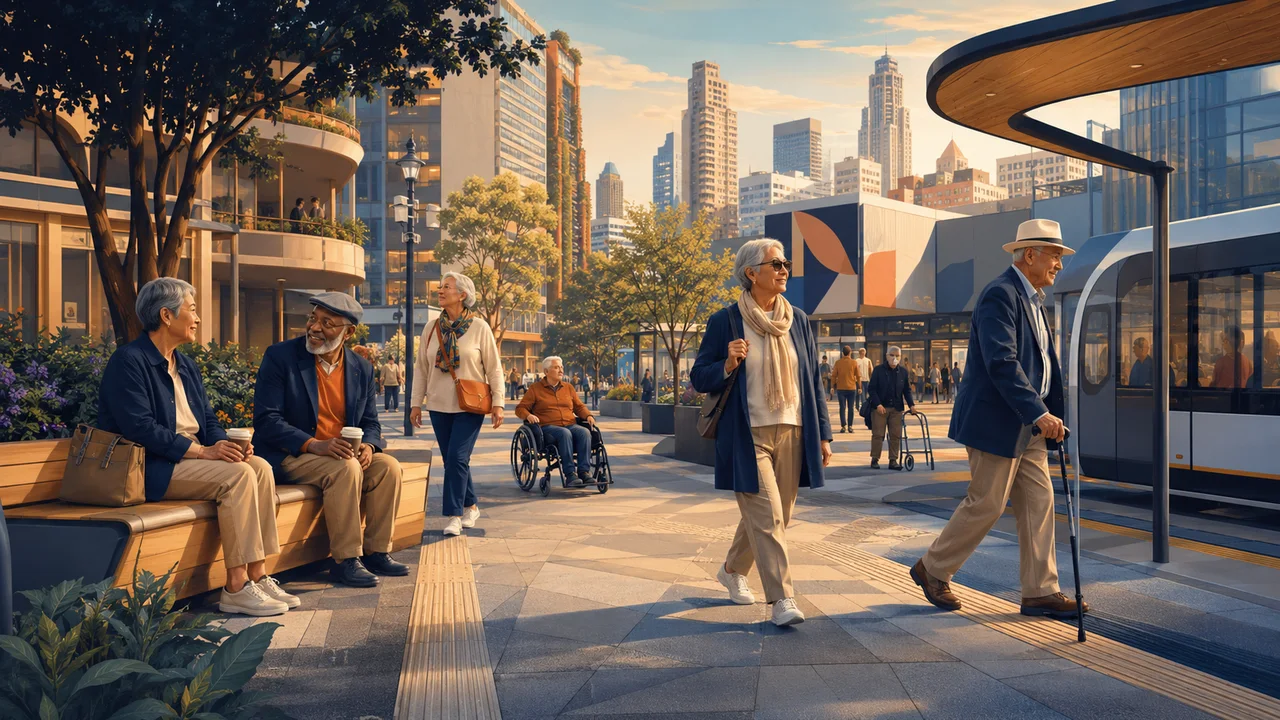
Age-friendly cities combine accessible transport, housing, public space, services and opportunities for participation across generations. Age-friendly urban design benefits more than older residents. A street that is easier to cross, a bus that can be boarded without steps and a home that can adapt to changing mobility also help children, caregivers and people recovering from illness. Cities should involve older people directly because chronological age alone does not describe ability, income, culture, health or preferred way of living.
A grounded account of age-friendly cities needs to answer more than whether the idea sounds promising. It must explain accessible streets, adaptable housing, public transport, health and care access, social participation, and intergenerational design, show how these elements interact and identify where evidence remains limited. That structure helps readers compare options without assuming that one product, policy or personal routine suits every setting.
The discussion considers the experience of residents, public agencies, service operators and community organisations and keeps the analytical boundary wide enough to include the complete journey through public systems, including people least well served. That matters because progress in age-friendly cities should be visible through service outcomes, local experience, geographic coverage and distribution across groups, not inferred from attention, purchase or participation alone.
Accessible streets in the context of How Cities Can Adapt to Ageing Populations
Accessible streets require continuous footpaths, safe surfaces, adequate crossing time, shade, seating and clear wayfinding. A single missing kerb ramp or blocked pavement can break an otherwise accessible route. Maintenance deserves the same attention as new construction. Audits should follow complete journeys to shops, parks, clinics and transit rather than rating isolated features.
Treating accessible streets seriously means connecting it with ownership. Someone must understand how it contributes to age-friendly cities, what support is available and what would trigger a change of direction. Residents, public agencies, service operators and community organisations should examine the complete journey through public systems, including people least well served. The aim is not to remove every uncertainty before acting; it is to make the material uncertainties visible enough that a limited, reversible first step can be chosen.
After the first trial of accessible streets, hold a short evidence review with residents, public agencies, service operators and community organisations. Compare the expected mechanism with what actually happened and use service outcomes, local experience, geographic coverage and distribution across groups to identify the difference. Separate a flaw in the idea from a flaw in setup or communication. Agree on one adjustment only, then repeat the observation. Controlled iteration produces clearer learning than a large redesign in which every variable changes at once.
One common mistake is to optimise the visible part of accessible streets while ignoring maintenance and recovery. In age-friendly cities, the long-term result depends on what happens after the first decision, when attention moves elsewhere and unusual cases appear. Document the smallest routine that keeps the improvement working. If that routine requires unavailable time, authority or skill, the design should be simplified before expansion rather than relying on permanent exceptional effort.
Adaptable housing in the context of How Cities Can Adapt to Ageing Populations
Adaptable housing allows people to remain safely at home as needs change. Step-free entrances, reachable controls, usable bathrooms and space for support can be incorporated into new buildings more cheaply than later retrofits. Cities also need diverse sizes, tenures and price points so downsizing or moving closer to services does not require leaving a familiar community.
A useful account of adaptable housing should state both the direct effect and the conditions required to produce it. In age-friendly cities, those conditions may sit with different members of residents, public agencies, service operators and community organisations. Mapping the complete journey through public systems, including people least well served reveals whether authority and responsibility are aligned. If one group is accountable for an outcome but cannot change the factors driving it, the implementation plan needs redesign rather than stronger motivational language.
Implementation should remain proportionate to consequence. For a low-risk decision about adaptable housing, a short trial and simple notes may be sufficient; a high-consequence part of age-friendly cities may require specialist review, formal approval and longer monitoring. In either case, collect service outcomes, local experience, geographic coverage and distribution across groups. Make support and complaint routes clear before launch. People should not have to experience a serious failure before discovering who is responsible for correction.
Cost should be understood broadly. The price of adaptable housing within age-friendly cities may include time, training, coordination, infrastructure and the burden of handling exceptions. A choice that looks inexpensive to one team may move unpaid work to customers, families or another public service. Record those transfers explicitly and compare them with the benefit before describing the approach as efficient.
This aspect of age-friendly cities also provides context for What Makes Public Transport Dependable?. Reading the two articles together helps distinguish a general decision principle from the specific evidence required by each topic.
Public transport in the context of How Cities Can Adapt to Ageing Populations
Public transport supports independence when stops are reachable, vehicles are accessible, service is frequent and information is understandable. Drivers and station staff influence the experience as much as equipment. Concessionary fares help only if routes connect homes with healthcare, food, social activity and family at times people actually travel.
A closer look at public transport changes what counts as progress in age-friendly cities. Adoption or activity alone is weak evidence. Residents, public agencies, service operators and community organisations should ask whether the intended outcome improved, whether the experience remained fair and whether the approach can be maintained. The analysis has to include the complete journey through public systems, including people least well served. This is where hidden dependencies usually become visible and where a promising idea can be strengthened before it expands.
Use a pre-mortem before changing public transport. Imagine that the planned approach to age-friendly cities has failed six months later and ask residents, public agencies, service operators and community organisations to suggest plausible causes. Group those causes around access, funding, responsibility, maintenance and fair distribution, then select signals from service outcomes, local experience, geographic coverage and distribution across groups that could provide early warning. Assign a response to the most serious risks. This exercise is useful because people can discuss weakness without having to oppose the whole idea.
Communication should distinguish established evidence, reasonable expectation and speculation. Claims about public transport in age-friendly cities become more trustworthy when readers can see the setting, timeframe and limitation behind them. Plain language does not require pretending the issue is simple. It requires defining specialised terms, explaining the consequence of uncertainty and showing which decision can responsibly be made with the information available now.
Health and care access in the context of How Cities Can Adapt to Ageing Populations
Health and care access depends on location, coordination and the ability to navigate services. Neighbourhood clinics, pharmacies, home support and telehealth can complement one another, but digital routes should not become the only route. Caregivers need information and respite, while emergency planning must identify residents who may require additional support during heat, outages or evacuation.
The consequences of health and care access may appear before, during and long after the main decision about age-friendly cities. That timing matters to residents, public agencies, service operators and community organisations, because an early convenience can be followed by maintenance, support or access problems. Review the complete journey through public systems, including people least well served at each stage and identify who has authority to respond. A benefit that depends on unresolved work being absorbed elsewhere should not be described as a complete improvement.
Begin with a walkthrough focused only on health and care access. In relation to age-friendly cities, ask one participant to describe the intended route and another to describe what happens when information, time or access is missing. Record service outcomes, local experience, geographic coverage and distribution across groups before proposing a fix. The contrast usually reveals assumptions hidden in the official process. Select the correction with the greatest expected benefit that can still be reversed if the result disappoints.
Equity also needs an explicit check. The average result for health and care access may hide a poor experience for beginners, smaller organisations, people with disabilities or communities with fewer resources. A sound discussion of age-friendly cities compares outcomes across relevant groups and invites examples from the edges. The purpose is not to guarantee an identical experience in every circumstance, but to avoid calling a result successful while predictable barriers remain unexamined.
For a useful comparison with age-friendly cities, read Why Affordable Housing Needs Multiple Solutions. Its subject is different, but it shows how neighbouring world choices can expose dependencies that a narrow review misses.
Social participation in the context of How Cities Can Adapt to Ageing Populations
Social participation grows through repeated, low-pressure opportunities to contribute. Libraries, parks, cultural groups, volunteering and lifelong learning can reduce isolation when programmes are affordable and accessible. Older residents should be treated as participants with experience and skills, not only as recipients of care. Transport and information often determine whether an invitation becomes real participation.
Different participants may use the phrase social participation while referring to different problems. In a discussion of age-friendly cities, residents, public agencies, service operators and community organisations should define the term with a concrete example and relate it to access, funding, responsibility, maintenance and fair distribution. This avoids false agreement. It also makes it possible to inspect the complete journey through public systems, including people least well served and decide whether the proposed action addresses the original need or merely changes the most visible symptom.
A useful workshop on social participation would bring together residents, public agencies, service operators and community organisations and map the experience from first contact through normal use, exception and recovery. Link each stage to age-friendly cities and identify what information, skill or resource is required. Choose evidence from service outcomes, local experience, geographic coverage and distribution across groups, but do not let measurement displace the outcome. A metric is worth keeping only when a change in it would lead to a specific decision.
Responsibility should continue after launch. Decisions about social participation in age-friendly cities need an owner who can answer questions, maintain the approach and respond when conditions change. Name a backup and keep essential information where the relevant people can find it. When responsibility exists only during a project meeting, predictable problems become urgent surprises and the people affected are left to discover their own workaround.
Intergenerational design in the context of How Cities Can Adapt to Ageing Populations
Intergenerational design creates places where different age groups can meet without forcing interaction. Mixed-use neighbourhoods, shared community facilities, schools near public spaces and varied housing can support everyday contact. Programmes should avoid stereotypes and build reciprocity—for example, exchanging local knowledge, digital support, mentoring or practical skills in both directions.
In this context, intergenerational design is not an isolated feature. It shapes decisions about access, funding, responsibility, maintenance and fair distribution and influences the experience of residents, public agencies, service operators and community organisations. A responsible assessment follows the complete journey through public systems, including people least well served, including cases that do not use the preferred route. Those edge cases are useful design evidence. They reveal whether age-friendly cities works because the system is dependable or only because the first participants had unusual resources and support.
To act on intergenerational design, choose one real setting connected with age-friendly cities and document the baseline. Ask residents, public agencies, service operators and community organisations where friction, exclusion or misunderstanding currently occurs. Then test one bounded change and examine service outcomes, local experience, geographic coverage and distribution across groups. Avoid changing several elements at once, because the team will not know which produced the result. Agree in advance on a stop condition as well as a success measure; stopping a weak idea is a valid use of a pilot.
A resilience check asks what happens when normal resources are unavailable. For intergenerational design in age-friendly cities, consider loss of connectivity, staff absence, budget pressure, increased demand or a participant needing a different route. The response does not have to replicate ideal service perfectly, but it should protect the most important outcome. Testing recovery often reveals priorities more clearly than describing normal operation.
Within age-friendly cities, the decisions here connect naturally with Community Disaster Preparedness That Works, which explores another part of world where evidence, implementation and long-term responsibility must be considered together.
Six questions to ask about age-friendly cities
The following questions turn the six parts of age-friendly cities into a focused review. They can be used by readers, teams or community groups without assuming that every setting needs the same answer.
- What does accessible streets mean in this setting, and who experiences its effects first?
- Which current problem involving adaptable housing is the article trying to solve?
- What evidence would show that public transport improved rather than merely changed?
- Who owns the long-term work associated with health and care access, including exceptions?
- Which group could be poorly served by the preferred approach to social participation?
- What result would justify revising or stopping work on intergenerational design?
Conclusion: a balanced view of How Cities Can Adapt to Ageing Populations
How Cities Can Adapt to Ageing Populations becomes useful when its six dimensions—accessible streets, adaptable housing, public transport, health and care access, social participation, intergenerational design—are understood together. The central promise is age-friendly cities combine accessible transport, housing, public space, services and opportunities for participation across generations. That promise should remain connected to evidence, affected people and the resources required after the initial decision.
The next step is not automatic adoption or rejection. Choose one situation involving age-friendly cities, document the current outcome and test a proportionate improvement. Review the result honestly, preserve what helped and change or stop what did not. That creates a stronger basis for access, funding, responsibility, maintenance and fair distribution than confidence, novelty or fear alone.
Comments 0