
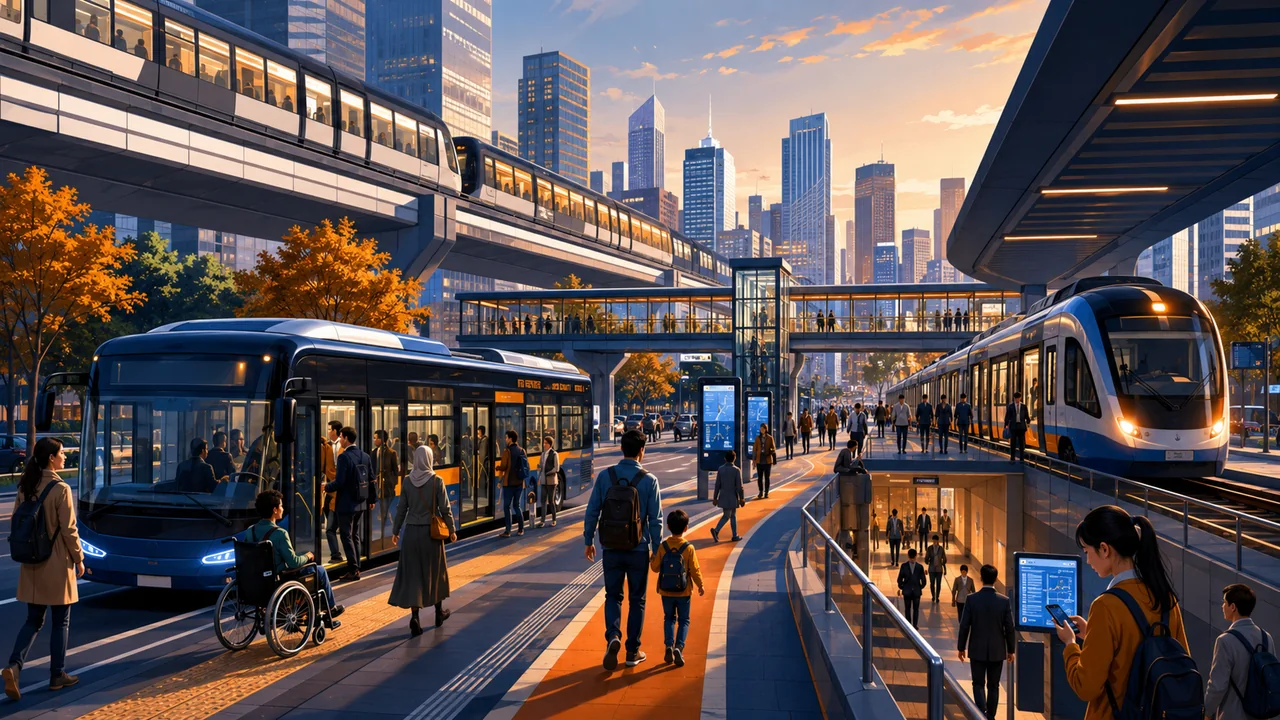
Dependable public transport requires frequency, coverage, affordability, accessibility and useful connections, not only impressive vehicles. Passengers experience public transport as a complete journey: reaching the stop, waiting, boarding, transferring, paying and arriving at a useful time. A modern vehicle cannot compensate for a route that rarely comes, ends too early or fails to connect with other services. Dependability therefore combines operations, street design, information, affordability and personal safety.
What Makes Public Transport Dependable? is best understood by separating its main components and then reconnecting them. The sections below examine service frequency, network coverage, reliable information, accessible design, integrated fares, and safe connections. These are not interchangeable labels: each describes a distinct decision, dependency or source of evidence. Together they show why the subject cannot be judged from one headline benefit or one alarming example.
The discussion considers the experience of residents, public agencies, service operators and community organisations and keeps the analytical boundary wide enough to include the complete journey through public systems, including people least well served. That matters because progress in dependable public transport should be visible through service outcomes, local experience, geographic coverage and distribution across groups, not inferred from attention, purchase or participation alone.
Service frequency in the context of What Makes Public Transport Dependable?
Service frequency determines whether passengers must plan their day around a timetable. Frequent service reduces the penalty of a missed vehicle and makes spontaneous trips possible. Reliability still matters: bunching can create a long wait followed by several vehicles together. Agencies should publish on-time and headway performance and address causes such as traffic delay, boarding time and unrealistic schedules.
The value of service frequency becomes clearer when it is compared with a credible alternative. For dependable public transport, the comparison may be the current method, a simpler change or a different allocation of resources. Residents, public agencies, service operators and community organisations should assess each option across the complete journey through public systems, including people least well served. The preferred route should explain not only what it improves but also why its additional cost, complexity or constraint is justified.
A useful workshop on service frequency would bring together residents, public agencies, service operators and community organisations and map the experience from first contact through normal use, exception and recovery. Link each stage to dependable public transport and identify what information, skill or resource is required. Choose evidence from service outcomes, local experience, geographic coverage and distribution across groups, but do not let measurement displace the outcome. A metric is worth keeping only when a change in it would lead to a specific decision.
Equity also needs an explicit check. The average result for service frequency may hide a poor experience for beginners, smaller organisations, people with disabilities or communities with fewer resources. A sound discussion of dependable public transport compares outcomes across relevant groups and invites examples from the edges. The purpose is not to guarantee an identical experience in every circumstance, but to avoid calling a result successful while predictable barriers remain unexamined.
Network coverage in the context of What Makes Public Transport Dependable?
Network coverage should connect homes with employment, education, healthcare, shopping and social life. A route map can appear extensive while requiring long walks or multiple indirect transfers. Planning should use travel needs across the full day, not only central-city commuting peaks. Lower-density areas may require coordinated feeder, demand-responsive or community services rather than abandonment.
Questions about network coverage involve both design and behaviour. A technically capable approach to dependable public transport may still fail if expectations, incentives or everyday routines work against it. Residents, public agencies, service operators and community organisations should examine the complete journey through public systems, including people least well served and identify the moment when people are most likely to abandon, misunderstand or work around the intended process. That moment is often a better starting point than adding another feature.
Create a small comparison table for network coverage: current method, proposed method and a simpler alternative. Judge all three against the same outcome for dependable public transport, using service outcomes, local experience, geographic coverage and distribution across groups. Include setup and ongoing work, not only headline cost or performance. Invite a person affected by each option to challenge the assumptions. Document why the final choice was made so later reviewers can distinguish a poor decision from conditions that subsequently changed.
A resilience check asks what happens when normal resources are unavailable. For network coverage in dependable public transport, consider loss of connectivity, staff absence, budget pressure, increased demand or a participant needing a different route. The response does not have to replicate ideal service perfectly, but it should protect the most important outcome. Testing recovery often reveals priorities more clearly than describing normal operation.
Within dependable public transport, the decisions here connect naturally with How Cities Can Adapt to Ageing Populations, which explores another part of world where evidence, implementation and long-term responsibility must be considered together.
Reliable information in the context of What Makes Public Transport Dependable?
Reliable information includes planned schedules, real-time updates, disruption explanations and alternatives. Displays, announcements, websites and apps should agree and remain accessible to people with visual, hearing, language or digital-access needs. During disruption, passengers need specific instructions about where to wait or transfer. Silence damages trust even when the original delay was unavoidable.
The important shift is from recognising reliable information as a desirable phrase to defining how it changes a real decision about dependable public transport. Residents, public agencies, service operators and community organisations may see different consequences, so the decision record should state whose experience is being used and whose may still be missing. The boundary for analysis is the complete journey through public systems, including people least well served. Keeping that boundary visible prevents an attractive improvement in one place from transferring cost, risk or effort somewhere less visible.
Begin with a walkthrough focused only on reliable information. In relation to dependable public transport, ask one participant to describe the intended route and another to describe what happens when information, time or access is missing. Record service outcomes, local experience, geographic coverage and distribution across groups before proposing a fix. The contrast usually reveals assumptions hidden in the official process. Select the correction with the greatest expected benefit that can still be reversed if the result disappoints.
Cost should be understood broadly. The price of reliable information within dependable public transport may include time, training, coordination, infrastructure and the burden of handling exceptions. A choice that looks inexpensive to one team may move unpaid work to customers, families or another public service. Record those transfers explicitly and compare them with the benefit before describing the approach as efficient.
Accessible design in the context of What Makes Public Transport Dependable?
Accessible design follows the complete path from pavement to seat. Step-free boarding, tactile guidance, usable ticket machines, priority space, audio-visual stop information and trained staff support many passengers. A lift outage or blocked footpath can make an accessible station unusable. Agencies should provide current accessibility status and an effective route for requesting assistance or reporting barriers.
The practical significance of accessible design lies in the choices it creates for residents, public agencies, service operators and community organisations. Within dependable public transport, those choices affect access, funding, responsibility, maintenance and fair distribution. A narrow review may report the easiest benefit and miss the wider experience. Following the complete journey through public systems, including people least well served gives reviewers a more honest view of who gains convenience, who assumes new responsibility and which failures require a human route rather than another instruction.
After the first trial of accessible design, hold a short evidence review with residents, public agencies, service operators and community organisations. Compare the expected mechanism with what actually happened and use service outcomes, local experience, geographic coverage and distribution across groups to identify the difference. Separate a flaw in the idea from a flaw in setup or communication. Agree on one adjustment only, then repeat the observation. Controlled iteration produces clearer learning than a large redesign in which every variable changes at once.
Privacy, dignity and autonomy may be affected even when they are not the primary purpose of accessible design. In dependable public transport, ask what information is collected, which choices remain available and whether refusing the preferred route creates a penalty. Proportionate safeguards should match the consequence. People need enough explanation to participate knowingly and a realistic way to correct a mistake or challenge an important outcome.
Within dependable public transport, the decisions here connect naturally with Why Affordable Housing Needs Multiple Solutions, which explores another part of world where evidence, implementation and long-term responsibility must be considered together.
Integrated fares in the context of What Makes Public Transport Dependable?
Integrated fares allow transfers without repeated penalties and make the network feel like one service. Fare caps, concessions and simple products can improve affordability, but cashless systems must include people without bank accounts or smartphones. Regional boundaries should not create confusing rules for ordinary journeys. Evaluation should consider the total household cost of reaching essential destinations.
A useful account of integrated fares should state both the direct effect and the conditions required to produce it. In dependable public transport, those conditions may sit with different members of residents, public agencies, service operators and community organisations. Mapping the complete journey through public systems, including people least well served reveals whether authority and responsibility are aligned. If one group is accountable for an outcome but cannot change the factors driving it, the implementation plan needs redesign rather than stronger motivational language.
Set a decision threshold for integrated fares before investing further in dependable public transport. The threshold might concern quality, access, cost, reliability or harm, depending on the subject. Use service outcomes, local experience, geographic coverage and distribution across groups and explain how long the observation must run. If the threshold is missed, decide whether the cause can reasonably be corrected. This protects the review from being rewritten after results appear simply to defend the preferred option.
Review must include the option to stop. Investments of time, money or reputation can make teams defend integrated fares after its value has weakened. For dependable public transport, decide beforehand which result would justify revision or withdrawal. Preserve lessons from an unsuccessful test and explain them without blame. This creates a culture in which evidence can change direction, making future pilots more honest and less likely to repeat hidden assumptions.
Safe connections in the context of What Makes Public Transport Dependable?
Safe connections involve lighting, visibility, crossings, waiting areas and service coordination. Long waits at an isolated interchange can undermine an otherwise efficient trip. Timetables should protect important late-night transfers where possible. Safety planning must include harassment reporting and staff response while avoiding enforcement practices that make some communities less willing to use the system.
The consequences of safe connections may appear before, during and long after the main decision about dependable public transport. That timing matters to residents, public agencies, service operators and community organisations, because an early convenience can be followed by maintenance, support or access problems. Review the complete journey through public systems, including people least well served at each stage and identify who has authority to respond. A benefit that depends on unresolved work being absorbed elsewhere should not be described as a complete improvement.
A practical review can begin with three columns: the current position on safe connections, the change being considered and the evidence that would justify keeping it. For dependable public transport, suitable evidence includes service outcomes, local experience, geographic coverage and distribution across groups. Select a small number of measures before the result is known, add direct observations and record exceptions. Set a review date and name the person able to correct the design. If the evidence is mixed, retain the useful element while narrowing or revising the weak one.
The language used to describe safe connections influences expectations. Marketing, policy or personal advice about dependable public transport should not turn a conditional benefit into a guaranteed outcome. State who the approach is intended for, what effort it requires and which limitations remain. Precise language helps suitable users make an informed choice and reduces disappointment that might otherwise be blamed on the people least able to influence the design.
For a useful comparison with dependable public transport, read Community Disaster Preparedness That Works. Its subject is different, but it shows how neighbouring world choices can expose dependencies that a narrow review misses.
Six questions to ask about dependable public transport
The following questions turn the six parts of dependable public transport into a focused review. They can be used by readers, teams or community groups without assuming that every setting needs the same answer.
- What does service frequency mean in this setting, and who experiences its effects first?
- Which current problem involving network coverage is the article trying to solve?
- What evidence would show that reliable information improved rather than merely changed?
- Who owns the long-term work associated with accessible design, including exceptions?
- Which group could be poorly served by the preferred approach to integrated fares?
- What result would justify revising or stopping work on safe connections?
Conclusion: a balanced view of What Makes Public Transport Dependable?
What Makes Public Transport Dependable? becomes useful when its six dimensions—service frequency, network coverage, reliable information, accessible design, integrated fares, safe connections—are understood together. The central promise is dependable public transport requires frequency, coverage, affordability, accessibility and useful connections, not only impressive vehicles. That promise should remain connected to evidence, affected people and the resources required after the initial decision.
The next step is not automatic adoption or rejection. Choose one situation involving dependable public transport, document the current outcome and test a proportionate improvement. Review the result honestly, preserve what helped and change or stop what did not. That creates a stronger basis for access, funding, responsibility, maintenance and fair distribution than confidence, novelty or fear alone.
Comments 0