
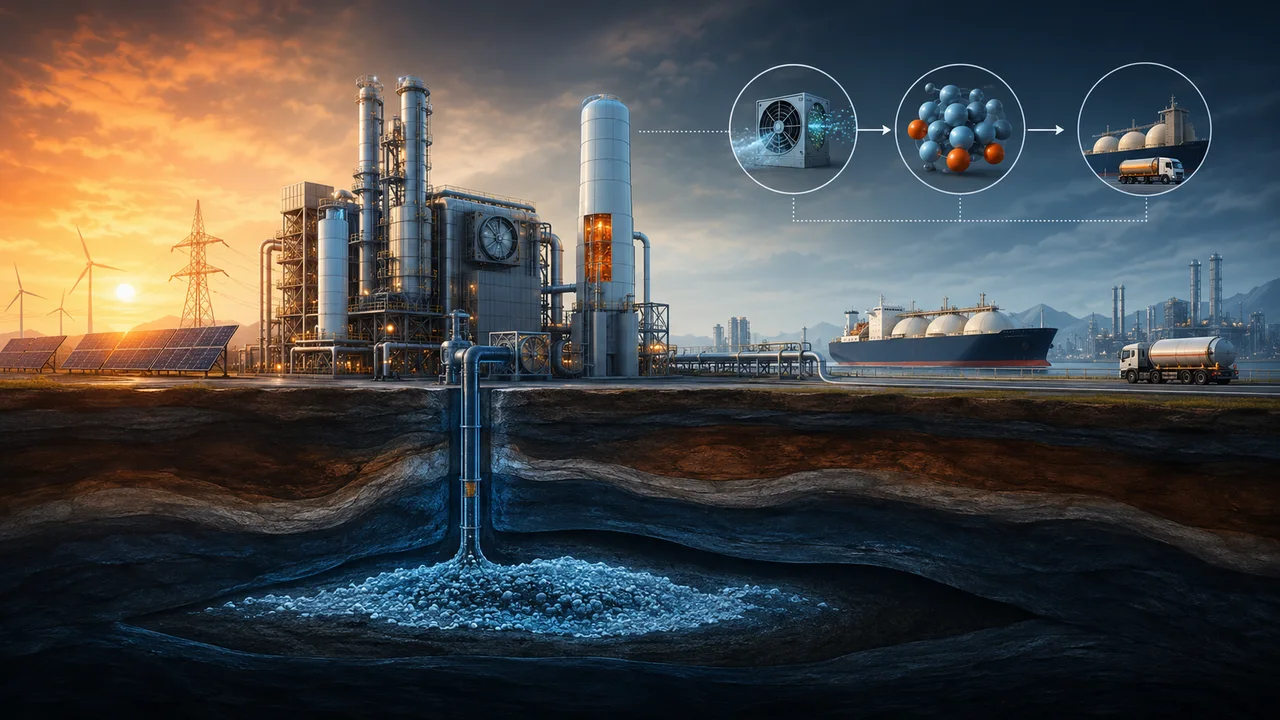
Carbon capture may help in difficult industrial sectors, but cost, energy, storage and emissions reduction must be evaluated honestly. Carbon capture describes processes that separate carbon dioxide from an industrial stream or directly from ambient air, followed by use or long-term storage. The technologies differ substantially in concentration, energy demand and cost. They may contribute in selected hard-to-abate sectors, but they do not remove the need to reduce fossil-fuel use, improve efficiency and expand low-carbon energy.
This guide develops carbon capture through six specific lenses: capture methods, energy requirements, transport networks, storage permanence, industrial uses, and role in climate strategy. The purpose is practical understanding. Readers should be able to recognise the mechanism, ask better questions of a provider or decision-maker and choose a proportionate next step without treating uncertainty as either proof of failure or permission for exaggerated claims.
The discussion considers the experience of researchers, engineers, policymakers and affected communities and keeps the analytical boundary wide enough to include the full system rather than the most favourable laboratory or project boundary. That matters because progress in carbon capture should be visible through replicated measurement, comparison, uncertainty ranges and long-term observation, not inferred from attention, purchase or participation alone.
Capture methods in the context of Carbon Capture: Uses, Limits and Trade-Offs
Capture methods include post-combustion separation from exhaust gases, pre-combustion approaches used in some industrial processes and direct air capture. Capturing from a concentrated stream is generally easier than separating the small share of carbon dioxide in ambient air. Performance should be assessed across the complete facility, including upstream energy and emissions, not only at the capture unit.
Questions about capture methods involve both design and behaviour. A technically capable approach to carbon capture may still fail if expectations, incentives or everyday routines work against it. Researchers, engineers, policymakers and affected communities should examine the full system rather than the most favourable laboratory or project boundary and identify the moment when people are most likely to abandon, misunderstand or work around the intended process. That moment is often a better starting point than adding another feature.
Begin with a walkthrough focused only on capture methods. In relation to carbon capture, ask one participant to describe the intended route and another to describe what happens when information, time or access is missing. Record replicated measurement, comparison, uncertainty ranges and long-term observation before proposing a fix. The contrast usually reveals assumptions hidden in the official process. Select the correction with the greatest expected benefit that can still be reversed if the result disappoints.
Learning should be preserved after the immediate decision. Keep a concise record of how capture methods was handled within carbon capture, the evidence considered and the reason for the choice. Include dissenting observations that may become important later. When staff, technology or circumstances change, this record prevents an old decision from continuing only because its original assumptions have been forgotten.
Energy requirements in the context of Carbon Capture: Uses, Limits and Trade-Offs
Energy requirements can be substantial because solvents must be regenerated, gases compressed and equipment operated. If that energy comes from high-emission sources, the net climate benefit falls. Evaluations should report additional fuel or electricity use and compare the captured amount with total lifecycle emissions. Efficiency improvements can reduce the size and cost of the capture problem.
Different participants may use the phrase energy requirements while referring to different problems. In a discussion of carbon capture, researchers, engineers, policymakers and affected communities should define the term with a concrete example and relate it to mechanism, comparative benefit, uncertainty, scale and lifecycle impact. This avoids false agreement. It also makes it possible to inspect the full system rather than the most favourable laboratory or project boundary and decide whether the proposed action addresses the original need or merely changes the most visible symptom.
Set a decision threshold for energy requirements before investing further in carbon capture. The threshold might concern quality, access, cost, reliability or harm, depending on the subject. Use replicated measurement, comparison, uncertainty ranges and long-term observation and explain how long the observation must run. If the threshold is missed, decide whether the cause can reasonably be corrected. This protects the review from being rewritten after results appear simply to defend the preferred option.
Privacy, dignity and autonomy may be affected even when they are not the primary purpose of energy requirements. In carbon capture, ask what information is collected, which choices remain available and whether refusing the preferred route creates a penalty. Proportionate safeguards should match the consequence. People need enough explanation to participate knowingly and a realistic way to correct a mistake or challenge an important outcome.
For a useful comparison with carbon capture, read Why Biodiversity Matters Close to Home. Its subject is different, but it shows how neighbouring science choices can expose dependencies that a narrow review misses.
Transport networks in the context of Carbon Capture: Uses, Limits and Trade-Offs
Transport networks move compressed carbon dioxide from capture sites to use or storage locations, commonly by pipeline and potentially by ship. Network planning must address impurities, pressure, corrosion, monitoring, emergency response and access for multiple emitters. Shared infrastructure can lower unit cost, but it also creates coordination questions about ownership, tariffs and long-term liability.
In this context, transport networks is not an isolated feature. It shapes decisions about mechanism, comparative benefit, uncertainty, scale and lifecycle impact and influences the experience of researchers, engineers, policymakers and affected communities. A responsible assessment follows the full system rather than the most favourable laboratory or project boundary, including cases that do not use the preferred route. Those edge cases are useful design evidence. They reveal whether carbon capture works because the system is dependable or only because the first participants had unusual resources and support.
Create a small comparison table for transport networks: current method, proposed method and a simpler alternative. Judge all three against the same outcome for carbon capture, using replicated measurement, comparison, uncertainty ranges and long-term observation. Include setup and ongoing work, not only headline cost or performance. Invite a person affected by each option to challenge the assumptions. Document why the final choice was made so later reviewers can distinguish a poor decision from conditions that subsequently changed.
Communication should distinguish established evidence, reasonable expectation and speculation. Claims about transport networks in carbon capture become more trustworthy when readers can see the setting, timeframe and limitation behind them. Plain language does not require pretending the issue is simple. It requires defining specialised terms, explaining the consequence of uncertainty and showing which decision can responsibly be made with the information available now.
Storage permanence in the context of Carbon Capture: Uses, Limits and Trade-Offs
Storage permanence depends on suitable geology, careful injection, monitoring and rules that continue after a project closes. Deep saline formations and depleted hydrocarbon reservoirs are commonly discussed options. Operators need to characterise the site, track pressure and possible migration, protect groundwater and define who remains responsible if monitoring identifies a problem decades later.
The important shift is from recognising storage permanence as a desirable phrase to defining how it changes a real decision about carbon capture. Researchers, engineers, policymakers and affected communities may see different consequences, so the decision record should state whose experience is being used and whose may still be missing. The boundary for analysis is the full system rather than the most favourable laboratory or project boundary. Keeping that boundary visible prevents an attractive improvement in one place from transferring cost, risk or effort somewhere less visible.
Use a pre-mortem before changing storage permanence. Imagine that the planned approach to carbon capture has failed six months later and ask researchers, engineers, policymakers and affected communities to suggest plausible causes. Group those causes around mechanism, comparative benefit, uncertainty, scale and lifecycle impact, then select signals from replicated measurement, comparison, uncertainty ranges and long-term observation that could provide early warning. Assign a response to the most serious risks. This exercise is useful because people can discuss weakness without having to oppose the whole idea.
Timing can change the conclusion. A short observation of storage permanence may capture novelty or setup problems rather than the durable effect on carbon capture. Choose a review period that reflects how the outcome develops and note seasonal or one-off influences. At the same time, define early warning signals that justify immediate action; waiting for a scheduled review is not responsible when evidence suggests preventable harm.
Within carbon capture, the decisions here connect naturally with Gene Editing Explained for Non-Specialists, which explores another part of science where evidence, implementation and long-term responsibility must be considered together.
Industrial uses in the context of Carbon Capture: Uses, Limits and Trade-Offs
Industrial uses are most relevant where process emissions are difficult to avoid, such as the carbon dioxide released during cement manufacture. Capture may also be considered for chemicals, refining or waste treatment, although alternatives and demand reduction must be compared. Using captured carbon in short-lived products or fuels usually delays release rather than providing permanent removal.
For carbon capture, industrial uses should be evaluated as part of a connected system. It influences mechanism, comparative benefit, uncertainty, scale and lifecycle impact, and those effects may appear at different times. Researchers, engineers, policymakers and affected communities need a shared description of the current situation before choosing an intervention. That description should cover the full system rather than the most favourable laboratory or project boundary; otherwise a successful first example may be treated as proof even though ordinary cases, exceptions or long-term responsibilities were never tested.
A useful workshop on industrial uses would bring together researchers, engineers, policymakers and affected communities and map the experience from first contact through normal use, exception and recovery. Link each stage to carbon capture and identify what information, skill or resource is required. Choose evidence from replicated measurement, comparison, uncertainty ranges and long-term observation, but do not let measurement displace the outcome. A metric is worth keeping only when a change in it would lead to a specific decision.
Review must include the option to stop. Investments of time, money or reputation can make teams defend industrial uses after its value has weakened. For carbon capture, decide beforehand which result would justify revision or withdrawal. Preserve lessons from an unsuccessful test and explain them without blame. This creates a culture in which evidence can change direction, making future pilots more honest and less likely to repeat hidden assumptions.
Role in climate strategy in the context of Carbon Capture: Uses, Limits and Trade-Offs
The role in climate strategy should be bounded by realistic delivery rates, cost and alternatives. Capture can support a portfolio but should not justify new high-emission assets on the assumption that future equipment will solve them. Plans need separate targets for direct emissions reduction, avoided emissions and durable removals so that different climate outcomes are not counted as equivalent.
The value of role in climate strategy becomes clearer when it is compared with a credible alternative. For carbon capture, the comparison may be the current method, a simpler change or a different allocation of resources. Researchers, engineers, policymakers and affected communities should assess each option across the full system rather than the most favourable laboratory or project boundary. The preferred route should explain not only what it improves but also why its additional cost, complexity or constraint is justified.
To act on role in climate strategy, choose one real setting connected with carbon capture and document the baseline. Ask researchers, engineers, policymakers and affected communities where friction, exclusion or misunderstanding currently occurs. Then test one bounded change and examine replicated measurement, comparison, uncertainty ranges and long-term observation. Avoid changing several elements at once, because the team will not know which produced the result. Agree in advance on a stop condition as well as a success measure; stopping a weak idea is a valid use of a pilot.
One common mistake is to optimise the visible part of role in climate strategy while ignoring maintenance and recovery. In carbon capture, the long-term result depends on what happens after the first decision, when attention moves elsewhere and unusual cases appear. Document the smallest routine that keeps the improvement working. If that routine requires unavailable time, authority or skill, the design should be simplified before expansion rather than relying on permanent exceptional effort.
Within carbon capture, the decisions here connect naturally with Why Battery Recycling Is Becoming Essential, which explores another part of science where evidence, implementation and long-term responsibility must be considered together.
Six questions to ask about carbon capture
A useful next step is to question each part of carbon capture separately. Short written answers make assumptions visible and show where evidence or specialist advice is still required.
- What does capture methods mean in this setting, and who experiences its effects first?
- Which current problem involving energy requirements is the article trying to solve?
- What evidence would show that transport networks improved rather than merely changed?
- Who owns the long-term work associated with storage permanence, including exceptions?
- Which group could be poorly served by the preferred approach to industrial uses?
- What result would justify revising or stopping work on role in climate strategy?
Conclusion: a balanced view of Carbon Capture: Uses, Limits and Trade-Offs
Carbon Capture: Uses, Limits and Trade-Offs becomes useful when its six dimensions—capture methods, energy requirements, transport networks, storage permanence, industrial uses, role in climate strategy—are understood together. The central promise is carbon capture may help in difficult industrial sectors, but cost, energy, storage and emissions reduction must be evaluated honestly. That promise should remain connected to evidence, affected people and the resources required after the initial decision.
The next step is not automatic adoption or rejection. Choose one situation involving carbon capture, document the current outcome and test a proportionate improvement. Review the result honestly, preserve what helped and change or stop what did not. That creates a stronger basis for mechanism, comparative benefit, uncertainty, scale and lifecycle impact than confidence, novelty or fear alone.
Nicely written, good one
https://bestassignmenthelp.com/