
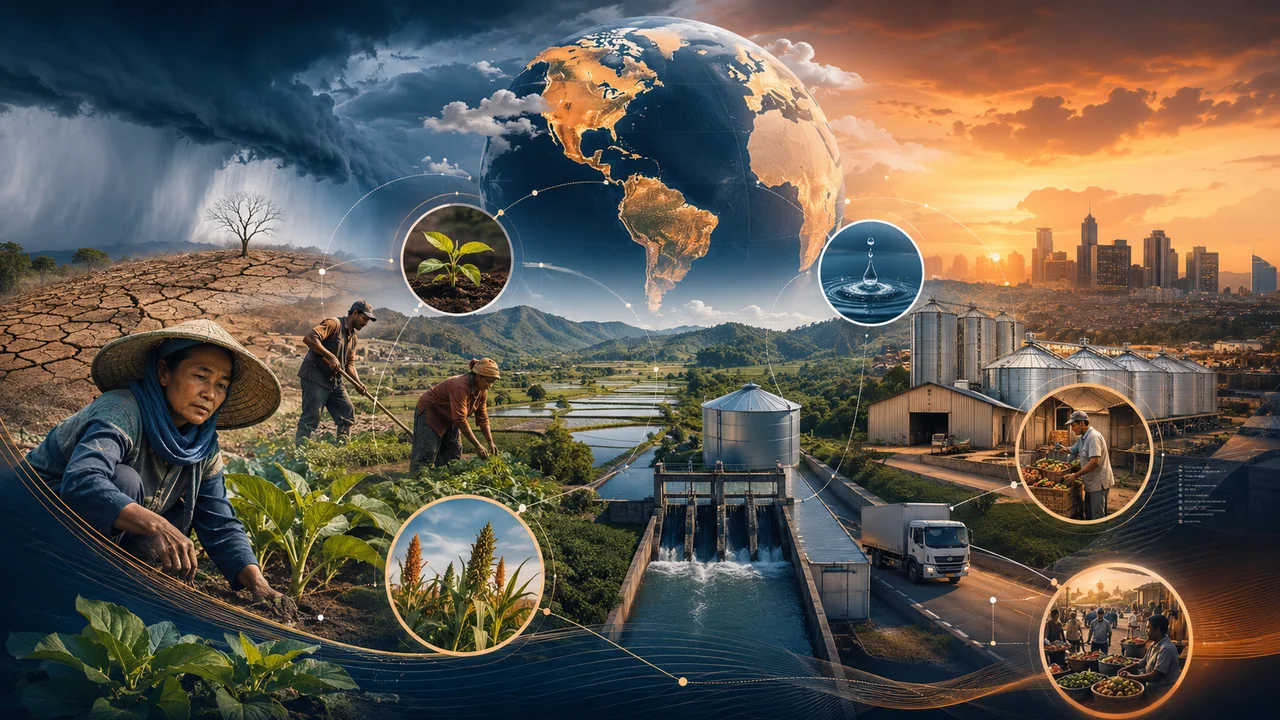
Food security depends on availability, access, nutrition and stability, all of which are influenced by climate, conflict, markets and resilient local systems. Food security exists when people have reliable physical and economic access to sufficient, safe and nutritious food that meets their needs and preferences. Climate change affects production, water, pests, transport and prices, but outcomes also depend on conflict, income, trade and governance. Resilience requires action from farms to markets and social protection, not one climate-resistant crop.
Food Security in a Changing Climate is best understood by separating its main components and then reconnecting them. The sections below examine climate risks, farmer resilience, storage and transport, affordability, nutrition quality, and early warning. These are not interchangeable labels: each describes a distinct decision, dependency or source of evidence. Together they show why the subject cannot be judged from one headline benefit or one alarming example.
The discussion considers the experience of residents, public agencies, service operators and community organisations and keeps the analytical boundary wide enough to include the complete journey through public systems, including people least well served. That matters because progress in climate-resilient food security should be visible through service outcomes, local experience, geographic coverage and distribution across groups, not inferred from attention, purchase or participation alone.
Climate risks in the context of Food Security in a Changing Climate
Climate risks include heat, drought, flood, shifting seasons, wildfire, sea-level rise and changing pests. Different crops, livestock and fisheries respond differently, and several hazards can occur together. Local climate information should be combined with farmer knowledge. Adaptation plans need ranges and contingency options rather than one forecast treated as certain.
The consequences of climate risks may appear before, during and long after the main decision about climate-resilient food security. That timing matters to residents, public agencies, service operators and community organisations, because an early convenience can be followed by maintenance, support or access problems. Review the complete journey through public systems, including people least well served at each stage and identify who has authority to respond. A benefit that depends on unresolved work being absorbed elsewhere should not be described as a complete improvement.
After the first trial of climate risks, hold a short evidence review with residents, public agencies, service operators and community organisations. Compare the expected mechanism with what actually happened and use service outcomes, local experience, geographic coverage and distribution across groups to identify the difference. Separate a flaw in the idea from a flaw in setup or communication. Agree on one adjustment only, then repeat the observation. Controlled iteration produces clearer learning than a large redesign in which every variable changes at once.
Learning should be preserved after the immediate decision. Keep a concise record of how climate risks was handled within climate-resilient food security, the evidence considered and the reason for the choice. Include dissenting observations that may become important later. When staff, technology or circumstances change, this record prevents an old decision from continuing only because its original assumptions have been forgotten.
Farmer resilience in the context of Food Security in a Changing Climate
Farmer resilience grows through soil and water management, diverse crops or livelihoods, suitable seed, extension services, insurance and secure access to land and finance. Smallholders may lack the capital to adopt even beneficial practices. Programmes should share risk and avoid locking farmers into inputs they cannot sustain. Adaptation must also protect workers from dangerous heat and exploitation.
For climate-resilient food security, farmer resilience should be evaluated as part of a connected system. It influences access, funding, responsibility, maintenance and fair distribution, and those effects may appear at different times. Residents, public agencies, service operators and community organisations need a shared description of the current situation before choosing an intervention. That description should cover the complete journey through public systems, including people least well served; otherwise a successful first example may be treated as proof even though ordinary cases, exceptions or long-term responsibilities were never tested.
A useful workshop on farmer resilience would bring together residents, public agencies, service operators and community organisations and map the experience from first contact through normal use, exception and recovery. Link each stage to climate-resilient food security and identify what information, skill or resource is required. Choose evidence from service outcomes, local experience, geographic coverage and distribution across groups, but do not let measurement displace the outcome. A metric is worth keeping only when a change in it would lead to a specific decision.
Timing can change the conclusion. A short observation of farmer resilience may capture novelty or setup problems rather than the durable effect on climate-resilient food security. Choose a review period that reflects how the outcome develops and note seasonal or one-off influences. At the same time, define early warning signals that justify immediate action; waiting for a scheduled review is not responsible when evidence suggests preventable harm.
For a useful comparison with climate-resilient food security, read How Migration Shapes Modern Cities. Its subject is different, but it shows how neighbouring world choices can expose dependencies that a narrow review misses.
Storage and transport in the context of Food Security in a Changing Climate
Storage and transport determine how much harvest reaches consumers. Drying, cooling, warehouses, roads, ports and market information reduce loss and stabilise supply, but they need energy and maintenance. Infrastructure should be designed for future hazards. Local processing can add resilience and value, while regional trade can move food from surplus to shortage when rules remain predictable.
Different participants may use the phrase storage and transport while referring to different problems. In a discussion of climate-resilient food security, residents, public agencies, service operators and community organisations should define the term with a concrete example and relate it to access, funding, responsibility, maintenance and fair distribution. This avoids false agreement. It also makes it possible to inspect the complete journey through public systems, including people least well served and decide whether the proposed action addresses the original need or merely changes the most visible symptom.
Begin with a walkthrough focused only on storage and transport. In relation to climate-resilient food security, ask one participant to describe the intended route and another to describe what happens when information, time or access is missing. Record service outcomes, local experience, geographic coverage and distribution across groups before proposing a fix. The contrast usually reveals assumptions hidden in the official process. Select the correction with the greatest expected benefit that can still be reversed if the result disappoints.
Review must include the option to stop. Investments of time, money or reputation can make teams defend storage and transport after its value has weakened. For climate-resilient food security, decide beforehand which result would justify revision or withdrawal. Preserve lessons from an unsuccessful test and explain them without blame. This creates a culture in which evidence can change direction, making future pilots more honest and less likely to repeat hidden assumptions.
Affordability in the context of Food Security in a Changing Climate
Affordability can deteriorate even when food is physically present. Climate shocks may raise prices while households lose income. Cash transfers, school meals, public distribution and emergency support can protect access when they are timely and inclusive. Price controls or export restrictions may have unintended effects, so policies should consider producers, consumers and neighbouring markets together.
In this context, affordability is not an isolated feature. It shapes decisions about access, funding, responsibility, maintenance and fair distribution and influences the experience of residents, public agencies, service operators and community organisations. A responsible assessment follows the complete journey through public systems, including people least well served, including cases that do not use the preferred route. Those edge cases are useful design evidence. They reveal whether climate-resilient food security works because the system is dependable or only because the first participants had unusual resources and support.
Use a pre-mortem before changing affordability. Imagine that the planned approach to climate-resilient food security has failed six months later and ask residents, public agencies, service operators and community organisations to suggest plausible causes. Group those causes around access, funding, responsibility, maintenance and fair distribution, then select signals from service outcomes, local experience, geographic coverage and distribution across groups that could provide early warning. Assign a response to the most serious risks. This exercise is useful because people can discuss weakness without having to oppose the whole idea.
The language used to describe affordability influences expectations. Marketing, policy or personal advice about climate-resilient food security should not turn a conditional benefit into a guaranteed outcome. State who the approach is intended for, what effort it requires and which limitations remain. Precise language helps suitable users make an informed choice and reduces disappointment that might otherwise be blamed on the people least able to influence the design.
This aspect of climate-resilient food security also provides context for Why Global Supply Chains Are Being Rethought. Reading the two articles together helps distinguish a general decision principle from the specific evidence required by each topic.
Nutrition quality in the context of Food Security in a Changing Climate
Nutrition quality matters alongside calories. A crisis response dominated by a few staples can prevent hunger while worsening micronutrient deficiency or diet-related disease over time. Support diverse production and markets, safe water, maternal and child nutrition and culturally appropriate foods. Fortification may help selected gaps but does not replace a varied food system.
Treating nutrition quality seriously means connecting it with ownership. Someone must understand how it contributes to climate-resilient food security, what support is available and what would trigger a change of direction. Residents, public agencies, service operators and community organisations should examine the complete journey through public systems, including people least well served. The aim is not to remove every uncertainty before acting; it is to make the material uncertainties visible enough that a limited, reversible first step can be chosen.
To act on nutrition quality, choose one real setting connected with climate-resilient food security and document the baseline. Ask residents, public agencies, service operators and community organisations where friction, exclusion or misunderstanding currently occurs. Then test one bounded change and examine service outcomes, local experience, geographic coverage and distribution across groups. Avoid changing several elements at once, because the team will not know which produced the result. Agree in advance on a stop condition as well as a success measure; stopping a weak idea is a valid use of a pilot.
Communication should distinguish established evidence, reasonable expectation and speculation. Claims about nutrition quality in climate-resilient food security become more trustworthy when readers can see the setting, timeframe and limitation behind them. Plain language does not require pretending the issue is simple. It requires defining specialised terms, explaining the consequence of uncertainty and showing which decision can responsibly be made with the information available now.
Early warning in the context of Food Security in a Changing Climate
Early warning combines weather, crop conditions, prices, conflict, nutrition and household coping signals. Information must trigger funded action; accurate alerts without response do not prevent harm. Community observations can reveal local deterioration before national averages. Plans should identify thresholds, responsibilities and pre-agreed financing so help begins before families sell essential assets or reduce meals.
The important shift is from recognising early warning as a desirable phrase to defining how it changes a real decision about climate-resilient food security. Residents, public agencies, service operators and community organisations may see different consequences, so the decision record should state whose experience is being used and whose may still be missing. The boundary for analysis is the complete journey through public systems, including people least well served. Keeping that boundary visible prevents an attractive improvement in one place from transferring cost, risk or effort somewhere less visible.
A practical review can begin with three columns: the current position on early warning, the change being considered and the evidence that would justify keeping it. For climate-resilient food security, suitable evidence includes service outcomes, local experience, geographic coverage and distribution across groups. Select a small number of measures before the result is known, add direct observations and record exceptions. Set a review date and name the person able to correct the design. If the evidence is mixed, retain the useful element while narrowing or revising the weak one.
Equity also needs an explicit check. The average result for early warning may hide a poor experience for beginners, smaller organisations, people with disabilities or communities with fewer resources. A sound discussion of climate-resilient food security compares outcomes across relevant groups and invites examples from the edges. The purpose is not to guarantee an identical experience in every circumstance, but to avoid calling a result successful while predictable barriers remain unexamined.
For a useful comparison with climate-resilient food security, read Why Media Freedom Matters to Everyone. Its subject is different, but it shows how neighbouring world choices can expose dependencies that a narrow review misses.
Six questions to ask about climate-resilient food security
The following questions turn the six parts of climate-resilient food security into a focused review. They can be used by readers, teams or community groups without assuming that every setting needs the same answer.
- What does climate risks mean in this setting, and who experiences its effects first?
- Which current problem involving farmer resilience is the article trying to solve?
- What evidence would show that storage and transport improved rather than merely changed?
- Who owns the long-term work associated with affordability, including exceptions?
- Which group could be poorly served by the preferred approach to nutrition quality?
- What result would justify revising or stopping work on early warning?
Conclusion: a balanced view of Food Security in a Changing Climate
Food Security in a Changing Climate becomes useful when its six dimensions—climate risks, farmer resilience, storage and transport, affordability, nutrition quality, early warning—are understood together. The central promise is food security depends on availability, access, nutrition and stability, all of which are influenced by climate, conflict, markets and resilient local systems. That promise should remain connected to evidence, affected people and the resources required after the initial decision.
The next step is not automatic adoption or rejection. Choose one situation involving climate-resilient food security, document the current outcome and test a proportionate improvement. Review the result honestly, preserve what helped and change or stop what did not. That creates a stronger basis for access, funding, responsibility, maintenance and fair distribution than confidence, novelty or fear alone.
Comments 0