
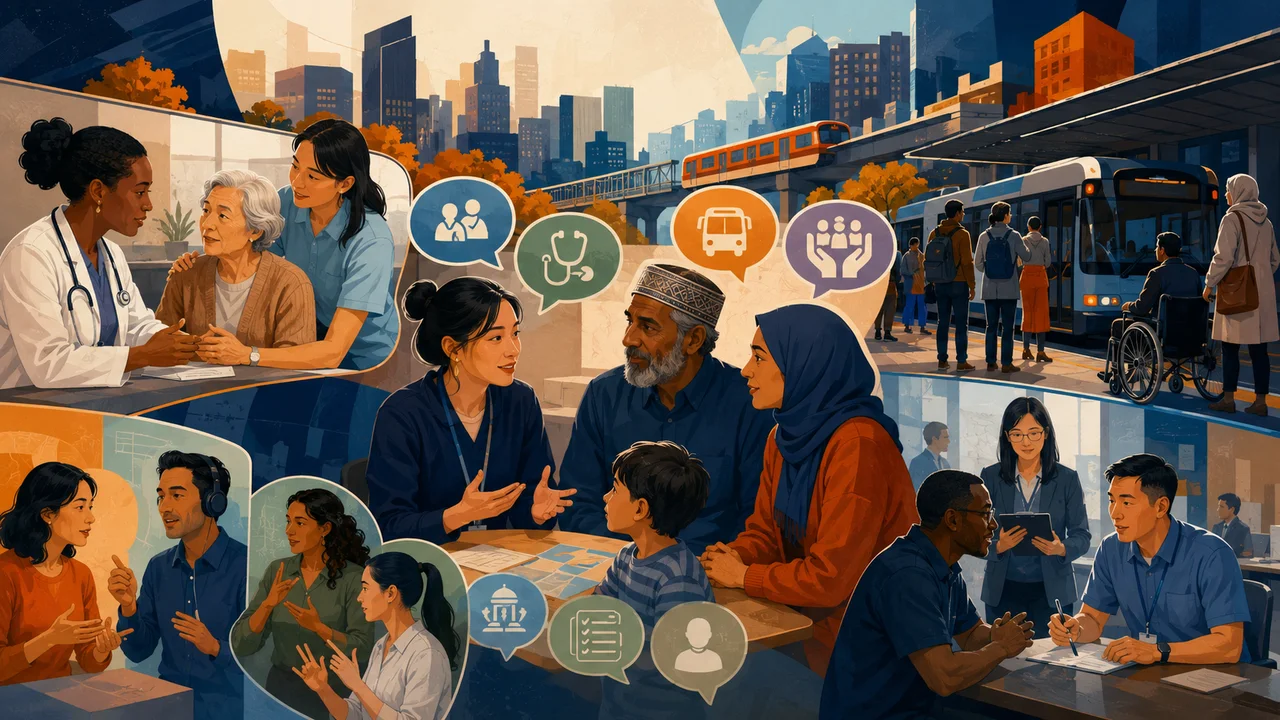
Multilingual cities improve access and trust when essential information, services and participation are designed beyond one dominant language. Multilingual cities contain residents who use different languages across home, work, education and public life. Equal access does not mean translating every message into every language. It means identifying essential decisions, understanding local language needs and providing accurate communication through suitable channels. Language access strengthens safety, trust and participation while recognising that language communities change over time.
This guide develops multilingual city services through six specific lenses: language mapping, essential translations, qualified interpretation, digital accessibility, community media, and inclusive participation. The purpose is practical understanding. Readers should be able to recognise the mechanism, ask better questions of a provider or decision-maker and choose a proportionate next step without treating uncertainty as either proof of failure or permission for exaggerated claims.
The discussion considers the experience of residents, public agencies, service operators and community organisations and keeps the analytical boundary wide enough to include the complete journey through public systems, including people least well served. That matters because progress in multilingual city services should be visible through service outcomes, local experience, geographic coverage and distribution across groups, not inferred from attention, purchase or participation alone.
Language mapping in the context of How Multilingual Cities Can Serve Everyone
Language mapping uses current demographic data, service records and community knowledge to identify where communication barriers occur. Household language, literacy and proficiency are different measures. Citywide averages may hide needs concentrated in one neighbourhood or service. Mapping should protect privacy and include sign languages, newly arriving groups and people who speak a common language but cannot read official forms easily.
In this context, language mapping is not an isolated feature. It shapes decisions about access, funding, responsibility, maintenance and fair distribution and influences the experience of residents, public agencies, service operators and community organisations. A responsible assessment follows the complete journey through public systems, including people least well served, including cases that do not use the preferred route. Those edge cases are useful design evidence. They reveal whether multilingual city services works because the system is dependable or only because the first participants had unusual resources and support.
Set a decision threshold for language mapping before investing further in multilingual city services. The threshold might concern quality, access, cost, reliability or harm, depending on the subject. Use service outcomes, local experience, geographic coverage and distribution across groups and explain how long the observation must run. If the threshold is missed, decide whether the cause can reasonably be corrected. This protects the review from being rewritten after results appear simply to defend the preferred option.
Privacy, dignity and autonomy may be affected even when they are not the primary purpose of language mapping. In multilingual city services, ask what information is collected, which choices remain available and whether refusing the preferred route creates a penalty. Proportionate safeguards should match the consequence. People need enough explanation to participate knowingly and a realistic way to correct a mistake or challenge an important outcome.
Essential translations in the context of How Multilingual Cities Can Serve Everyone
Essential translations should prioritise information affecting health, safety, legal rights, housing, education, elections and access to public support. Plain source text improves both translation quality and general comprehension. Materials need quality review, version control and rapid updating during emergencies. A translated brochure is not useful when the application, appointment system or follow-up remains available only in one language.
Different participants may use the phrase essential translations while referring to different problems. In a discussion of multilingual city services, residents, public agencies, service operators and community organisations should define the term with a concrete example and relate it to access, funding, responsibility, maintenance and fair distribution. This avoids false agreement. It also makes it possible to inspect the complete journey through public systems, including people least well served and decide whether the proposed action addresses the original need or merely changes the most visible symptom.
A useful workshop on essential translations would bring together residents, public agencies, service operators and community organisations and map the experience from first contact through normal use, exception and recovery. Link each stage to multilingual city services and identify what information, skill or resource is required. Choose evidence from service outcomes, local experience, geographic coverage and distribution across groups, but do not let measurement displace the outcome. A metric is worth keeping only when a change in it would lead to a specific decision.
Timing can change the conclusion. A short observation of essential translations may capture novelty or setup problems rather than the durable effect on multilingual city services. Choose a review period that reflects how the outcome develops and note seasonal or one-off influences. At the same time, define early warning signals that justify immediate action; waiting for a scheduled review is not responsible when evidence suggests preventable harm.
This aspect of multilingual city services also provides context for Digital Public Infrastructure Explained. Reading the two articles together helps distinguish a general decision principle from the specific evidence required by each topic.
Qualified interpretation in the context of How Multilingual Cities Can Serve Everyone
Qualified interpretation is necessary when live communication carries significant consequence. Professional interpreters understand accuracy, confidentiality and role boundaries; children, relatives or untrained staff may omit sensitive information or face inappropriate responsibility. Services need booking, telephone and video options plus a process for urgent use. Staff should speak directly to the resident rather than treating the interpreter as the decision-maker.
A closer look at qualified interpretation changes what counts as progress in multilingual city services. Adoption or activity alone is weak evidence. Residents, public agencies, service operators and community organisations should ask whether the intended outcome improved, whether the experience remained fair and whether the approach can be maintained. The analysis has to include the complete journey through public systems, including people least well served. This is where hidden dependencies usually become visible and where a promising idea can be strengthened before it expands.
Use a pre-mortem before changing qualified interpretation. Imagine that the planned approach to multilingual city services has failed six months later and ask residents, public agencies, service operators and community organisations to suggest plausible causes. Group those causes around access, funding, responsibility, maintenance and fair distribution, then select signals from service outcomes, local experience, geographic coverage and distribution across groups that could provide early warning. Assign a response to the most serious risks. This exercise is useful because people can discuss weakness without having to oppose the whole idea.
Equity also needs an explicit check. The average result for qualified interpretation may hide a poor experience for beginners, smaller organisations, people with disabilities or communities with fewer resources. A sound discussion of multilingual city services compares outcomes across relevant groups and invites examples from the edges. The purpose is not to guarantee an identical experience in every circumstance, but to avoid calling a result successful while predictable barriers remain unexamined.
Digital accessibility in the context of How Multilingual Cities Can Serve Everyone
Digital accessibility combines language access with usable websites, forms, captions and assistive-technology compatibility. Automatic translation may help with low-risk orientation but can fail with legal, medical or culturally specific language. Clearly label machine-translated content and provide human help for consequential tasks. Language selection should remain visible throughout a process instead of disappearing after the home page.
The value of digital accessibility becomes clearer when it is compared with a credible alternative. For multilingual city services, the comparison may be the current method, a simpler change or a different allocation of resources. Residents, public agencies, service operators and community organisations should assess each option across the complete journey through public systems, including people least well served. The preferred route should explain not only what it improves but also why its additional cost, complexity or constraint is justified.
To act on digital accessibility, choose one real setting connected with multilingual city services and document the baseline. Ask residents, public agencies, service operators and community organisations where friction, exclusion or misunderstanding currently occurs. Then test one bounded change and examine service outcomes, local experience, geographic coverage and distribution across groups. Avoid changing several elements at once, because the team will not know which produced the result. Agree in advance on a stop condition as well as a success measure; stopping a weak idea is a valid use of a pilot.
The language used to describe digital accessibility influences expectations. Marketing, policy or personal advice about multilingual city services should not turn a conditional benefit into a guaranteed outcome. State who the approach is intended for, what effort it requires and which limitations remain. Precise language helps suitable users make an informed choice and reduces disappointment that might otherwise be blamed on the people least able to influence the design.
This aspect of multilingual city services also provides context for Urban Loneliness and the Design of Connection. Reading the two articles together helps distinguish a general decision principle from the specific evidence required by each topic.
Community media in the context of How Multilingual Cities Can Serve Everyone
Community media includes local radio, newspapers, online groups and trusted organisations that understand audience context. Partnerships can extend urgent messages and reveal misinformation or service confusion. Public agencies should not turn community channels into one-way publicity or expect unpaid translation. Funding and editorial independence need clear arrangements, and official information should remain available for verification.
Treating community media seriously means connecting it with ownership. Someone must understand how it contributes to multilingual city services, what support is available and what would trigger a change of direction. Residents, public agencies, service operators and community organisations should examine the complete journey through public systems, including people least well served. The aim is not to remove every uncertainty before acting; it is to make the material uncertainties visible enough that a limited, reversible first step can be chosen.
Create a small comparison table for community media: current method, proposed method and a simpler alternative. Judge all three against the same outcome for multilingual city services, using service outcomes, local experience, geographic coverage and distribution across groups. Include setup and ongoing work, not only headline cost or performance. Invite a person affected by each option to challenge the assumptions. Document why the final choice was made so later reviewers can distinguish a poor decision from conditions that subsequently changed.
Communication should distinguish established evidence, reasonable expectation and speculation. Claims about community media in multilingual city services become more trustworthy when readers can see the setting, timeframe and limitation behind them. Plain language does not require pretending the issue is simple. It requires defining specialised terms, explaining the consequence of uncertainty and showing which decision can responsibly be made with the information available now.
Inclusive participation in the context of How Multilingual Cities Can Serve Everyone
Inclusive participation requires interpretation, translated background materials, suitable timing and more than one way to contribute to public decisions. Advisory groups should influence budgets, services or policy rather than symbolise diversity. Report how multilingual input changed the outcome. Residents also need protection from harassment and confidence that language difficulty will not be mistaken for lack of knowledge or civic commitment.
A useful account of inclusive participation should state both the direct effect and the conditions required to produce it. In multilingual city services, those conditions may sit with different members of residents, public agencies, service operators and community organisations. Mapping the complete journey through public systems, including people least well served reveals whether authority and responsibility are aligned. If one group is accountable for an outcome but cannot change the factors driving it, the implementation plan needs redesign rather than stronger motivational language.
Begin with a walkthrough focused only on inclusive participation. In relation to multilingual city services, ask one participant to describe the intended route and another to describe what happens when information, time or access is missing. Record service outcomes, local experience, geographic coverage and distribution across groups before proposing a fix. The contrast usually reveals assumptions hidden in the official process. Select the correction with the greatest expected benefit that can still be reversed if the result disappoints.
Learning should be preserved after the immediate decision. Keep a concise record of how inclusive participation was handled within multilingual city services, the evidence considered and the reason for the choice. Include dissenting observations that may become important later. When staff, technology or circumstances change, this record prevents an old decision from continuing only because its original assumptions have been forgotten.
For a useful comparison with multilingual city services, read How Community Energy Projects Work. Its subject is different, but it shows how neighbouring world choices can expose dependencies that a narrow review misses.
Six questions to ask about multilingual city services
A useful next step is to question each part of multilingual city services separately. Short written answers make assumptions visible and show where evidence or specialist advice is still required.
- What does language mapping mean in this setting, and who experiences its effects first?
- Which current problem involving essential translations is the article trying to solve?
- What evidence would show that qualified interpretation improved rather than merely changed?
- Who owns the long-term work associated with digital accessibility, including exceptions?
- Which group could be poorly served by the preferred approach to community media?
- What result would justify revising or stopping work on inclusive participation?
Conclusion: a balanced view of How Multilingual Cities Can Serve Everyone
How Multilingual Cities Can Serve Everyone becomes useful when its six dimensions—language mapping, essential translations, qualified interpretation, digital accessibility, community media, inclusive participation—are understood together. The central promise is multilingual cities improve access and trust when essential information, services and participation are designed beyond one dominant language. That promise should remain connected to evidence, affected people and the resources required after the initial decision.
The next step is not automatic adoption or rejection. Choose one situation involving multilingual city services, document the current outcome and test a proportionate improvement. Review the result honestly, preserve what helped and change or stop what did not. That creates a stronger basis for access, funding, responsibility, maintenance and fair distribution than confidence, novelty or fear alone.
Comments 0