
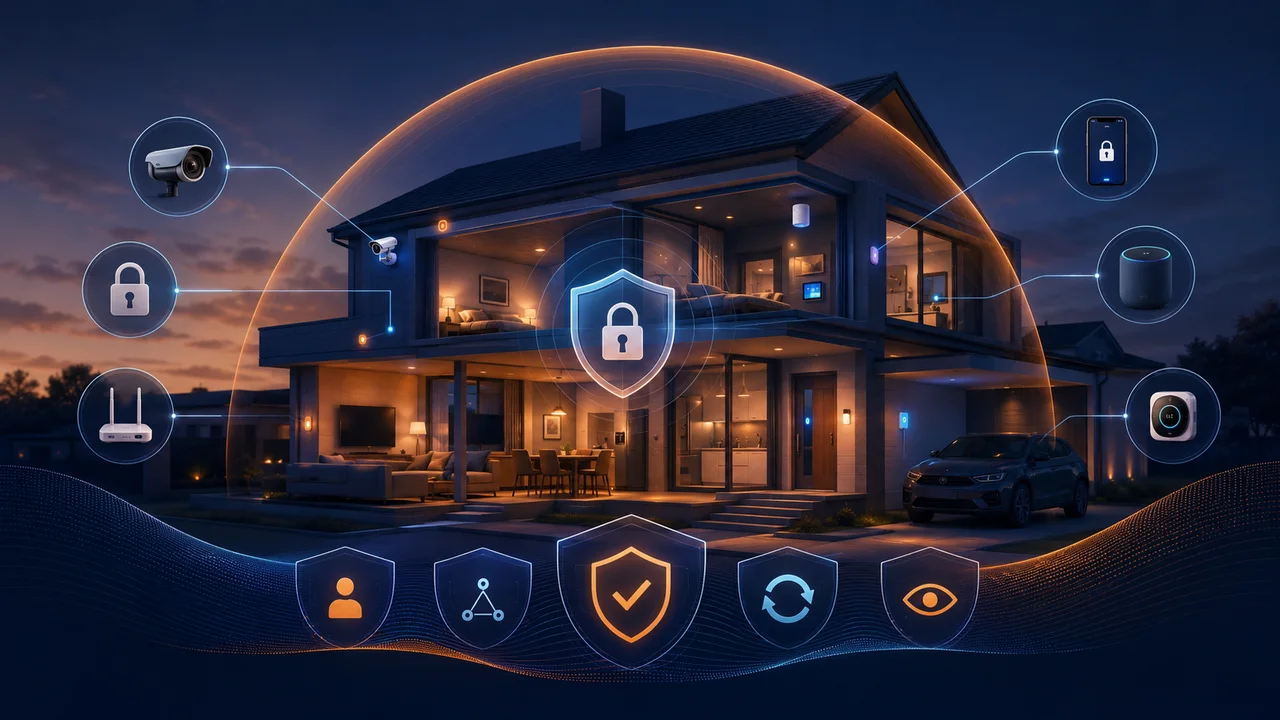
A smart home becomes safer when devices are updated, accounts are protected and convenience does not create unnecessary surveillance or fragile dependencies. A smart home joins sensors, cameras, speakers, locks, appliances and cloud services to household routines. Convenience can introduce new accounts, microphones, data flows and dependencies. Safety begins with understanding what is installed, keeping it supported and preserving manual ways to perform essential tasks. A connected lock or alarm should not become less usable when the internet or provider fails.
This guide develops safer smart homes through six specific lenses: device inventory, router security, account protection, camera privacy, offline controls, and safe disposal. The purpose is practical understanding. Readers should be able to recognise the mechanism, ask better questions of a provider or decision-maker and choose a proportionate next step without treating uncertainty as either proof of failure or permission for exaggerated claims.
The discussion considers the experience of users, administrators and product teams and keeps the analytical boundary wide enough to include connected services, device capability, data practices and human oversight. That matters because progress in safer smart homes should be visible through task completion, failure cases, security review, user control and support demand, not inferred from attention, purchase or participation alone.
Device inventory in the context of Building a Safer Smart Home
A device inventory records model, owner account, location, purpose, support status and data handled. Include devices built into appliances and systems inherited with a home. The inventory makes updates and removal possible and reveals products nobody still uses. Avoid connecting an item merely because connectivity exists; every account and service adds maintenance.
A closer look at device inventory changes what counts as progress in safer smart homes. Adoption or activity alone is weak evidence. Users, administrators and product teams should ask whether the intended outcome improved, whether the experience remained fair and whether the approach can be maintained. The analysis has to include connected services, device capability, data practices and human oversight. This is where hidden dependencies usually become visible and where a promising idea can be strengthened before it expands.
Begin with a walkthrough focused only on device inventory. In relation to safer smart homes, ask one participant to describe the intended route and another to describe what happens when information, time or access is missing. Record task completion, failure cases, security review, user control and support demand before proposing a fix. The contrast usually reveals assumptions hidden in the official process. Select the correction with the greatest expected benefit that can still be reversed if the result disappoints.
Learning should be preserved after the immediate decision. Keep a concise record of how device inventory was handled within safer smart homes, the evidence considered and the reason for the choice. Include dissenting observations that may become important later. When staff, technology or circumstances change, this record prevents an old decision from continuing only because its original assumptions have been forgotten.
Router security in the context of Building a Safer Smart Home
Router security protects the network path shared by smart devices. Change default administrator credentials, install firmware updates and use current wireless encryption supported by the equipment. A separate guest or device network can limit some exposure, but configuration must be understood. The router should be physically protected and its recovery information stored safely.
Treating router security seriously means connecting it with ownership. Someone must understand how it contributes to safer smart homes, what support is available and what would trigger a change of direction. Users, administrators and product teams should examine connected services, device capability, data practices and human oversight. The aim is not to remove every uncertainty before acting; it is to make the material uncertainties visible enough that a limited, reversible first step can be chosen.
Set a decision threshold for router security before investing further in safer smart homes. The threshold might concern quality, access, cost, reliability or harm, depending on the subject. Use task completion, failure cases, security review, user control and support demand and explain how long the observation must run. If the threshold is missed, decide whether the cause can reasonably be corrected. This protects the review from being rewritten after results appear simply to defend the preferred option.
One common mistake is to optimise the visible part of router security while ignoring maintenance and recovery. In safer smart homes, the long-term result depends on what happens after the first decision, when attention moves elsewhere and unusual cases appear. Document the smallest routine that keeps the improvement working. If that routine requires unavailable time, authority or skill, the design should be simplified before expansion rather than relying on permanent exceptional effort.
Within safer smart homes, the decisions here connect naturally with Why Open-Source Software Matters, which explores another part of technology where evidence, implementation and long-term responsibility must be considered together.
Account protection in the context of Building a Safer Smart Home
Account protection requires unique passwords, multifactor authentication where available and careful control of shared access. Give household members their own profiles when the platform supports it. Review integrations with voice assistants and automation services. When someone moves out or a contractor finishes, remove access promptly rather than assuming a changed Wi-Fi password covers every cloud account.
Scale changes the meaning of account protection. What works for a motivated first group may strain support, infrastructure or governance when safer smart homes reaches a wider audience. Users, administrators and product teams should model the effect on configuration, security, support and recovery and test connected services, device capability, data practices and human oversight under ordinary capacity, not only during a closely supported pilot. Expansion should be staged so evidence from one group can improve the experience of the next.
The first step is to turn account protection into a question that can be answered: what should become better, for whom and by when? Apply that question to safer smart homes, then gather task completion, failure cases, security review, user control and support demand. Numbers show scale, while conversations and observation explain the mechanism behind the pattern. Compare the result with a credible alternative, including the option of improving the current process. A new approach should earn expansion through evidence rather than novelty.
Timing can change the conclusion. A short observation of account protection may capture novelty or setup problems rather than the durable effect on safer smart homes. Choose a review period that reflects how the outcome develops and note seasonal or one-off influences. At the same time, define early warning signals that justify immediate action; waiting for a scheduled review is not responsible when evidence suggests preventable harm.
Camera privacy in the context of Building a Safer Smart Home
Camera privacy involves placement, recording, audio, retention and who can view footage. Avoid private spaces and consider neighbours, visitors, workers and children. Visible notice and local law may apply. Disable unnecessary remote access, protect shared links and review cloud storage. A camera can create evidence but may also create risk if an attacker or abusive household member gains control.
Different participants may use the phrase camera privacy while referring to different problems. In a discussion of safer smart homes, users, administrators and product teams should define the term with a concrete example and relate it to configuration, security, support and recovery. This avoids false agreement. It also makes it possible to inspect connected services, device capability, data practices and human oversight and decide whether the proposed action addresses the original need or merely changes the most visible symptom.
After the first trial of camera privacy, hold a short evidence review with users, administrators and product teams. Compare the expected mechanism with what actually happened and use task completion, failure cases, security review, user control and support demand to identify the difference. Separate a flaw in the idea from a flaw in setup or communication. Agree on one adjustment only, then repeat the observation. Controlled iteration produces clearer learning than a large redesign in which every variable changes at once.
Communication should distinguish established evidence, reasonable expectation and speculation. Claims about camera privacy in safer smart homes become more trustworthy when readers can see the setting, timeframe and limitation behind them. Plain language does not require pretending the issue is simple. It requires defining specialised terms, explaining the consequence of uncertainty and showing which decision can responsibly be made with the information available now.
This aspect of safer smart homes also provides context for Digital Accessibility Benefits Everyone. Reading the two articles together helps distinguish a general decision principle from the specific evidence required by each topic.
Offline controls in the context of Building a Safer Smart Home
Offline controls keep essential functions available during an outage or service closure. Lighting, heating, locks and alarms should have understandable manual operation and safe defaults. Test what happens when the internet, power or phone is unavailable. Store physical keys and instructions where authorised household members can reach them without advertising access to outsiders.
Questions about offline controls involve both design and behaviour. A technically capable approach to safer smart homes may still fail if expectations, incentives or everyday routines work against it. Users, administrators and product teams should examine connected services, device capability, data practices and human oversight and identify the moment when people are most likely to abandon, misunderstand or work around the intended process. That moment is often a better starting point than adding another feature.
Use a pre-mortem before changing offline controls. Imagine that the planned approach to safer smart homes has failed six months later and ask users, administrators and product teams to suggest plausible causes. Group those causes around configuration, security, support and recovery, then select signals from task completion, failure cases, security review, user control and support demand that could provide early warning. Assign a response to the most serious risks. This exercise is useful because people can discuss weakness without having to oppose the whole idea.
Responsibility should continue after launch. Decisions about offline controls in safer smart homes need an owner who can answer questions, maintain the approach and respond when conditions change. Name a backup and keep essential information where the relevant people can find it. When responsibility exists only during a project meeting, predictable problems become urgent surprises and the people affected are left to discover their own workaround.
Safe disposal in the context of Building a Safer Smart Home
Safe disposal includes factory reset, account removal and deletion of stored recordings or credentials before selling or recycling. Some devices retain memory cards or remain linked to a cloud account after local reset. Follow manufacturer and local e-waste guidance. Remove the product from the inventory and revoke its access tokens so an old device cannot reconnect later.
In this context, safe disposal is not an isolated feature. It shapes decisions about configuration, security, support and recovery and influences the experience of users, administrators and product teams. A responsible assessment follows connected services, device capability, data practices and human oversight, including cases that do not use the preferred route. Those edge cases are useful design evidence. They reveal whether safer smart homes works because the system is dependable or only because the first participants had unusual resources and support.
A useful workshop on safe disposal would bring together users, administrators and product teams and map the experience from first contact through normal use, exception and recovery. Link each stage to safer smart homes and identify what information, skill or resource is required. Choose evidence from task completion, failure cases, security review, user control and support demand, but do not let measurement displace the outcome. A metric is worth keeping only when a change in it would lead to a specific decision.
Cost should be understood broadly. The price of safe disposal within safer smart homes may include time, training, coordination, infrastructure and the burden of handling exceptions. A choice that looks inexpensive to one team may move unpaid work to customers, families or another public service. Record those transfers explicitly and compare them with the benefit before describing the approach as efficient.
For a useful comparison with safer smart homes, read How Recommendation Algorithms Shape Choices. Its subject is different, but it shows how neighbouring technology choices can expose dependencies that a narrow review misses.
Six questions to ask about safer smart homes
Before making a decision about safer smart homes, work through these six prompts. Each one corresponds to a section above and should be answered with a concrete example rather than a slogan.
- What does device inventory mean in this setting, and who experiences its effects first?
- Which current problem involving router security is the article trying to solve?
- What evidence would show that account protection improved rather than merely changed?
- Who owns the long-term work associated with camera privacy, including exceptions?
- Which group could be poorly served by the preferred approach to offline controls?
- What result would justify revising or stopping work on safe disposal?
Conclusion: a balanced view of Building a Safer Smart Home
Building a Safer Smart Home becomes useful when its six dimensions—device inventory, router security, account protection, camera privacy, offline controls, safe disposal—are understood together. The central promise is a smart home becomes safer when devices are updated, accounts are protected and convenience does not create unnecessary surveillance or fragile dependencies. That promise should remain connected to evidence, affected people and the resources required after the initial decision.
The next step is not automatic adoption or rejection. Choose one situation involving safer smart homes, document the current outcome and test a proportionate improvement. Review the result honestly, preserve what helped and change or stop what did not. That creates a stronger basis for configuration, security, support and recovery than confidence, novelty or fear alone.
Comments 0